Change Your Mind, Change Your World

Mind

Wisdom Within

The foolish person chases after happiness. The wise person creates the right conditions for happiness.

…..Mipham Rinpoche

What you see in the world is a reflection of your mind. You can’t change yourself by changing the world. You need to change your mind – then the world reflects the change of your mind.

Our Pristine Mind
Our Pristine Mind: A Practical Guide to Unconditional Happiness
Orgyen Chowang

Background on Orgyen  Chowang


How Can Change Be An Opportunity For Growth?

Change

Key To A Meaningful Life

The secret of living a meaningful and fulfilling life is to be ready – at every moment – to give up who you are for what you could become.

…..Brian Goodwin

Adapting To Change

In our fast-paced society, it’s not uncommon to reinvent a career time and again. It takes resilience to be able to adapt to whatever’s around the corner.

Learning As We Go

Sometimes obstacles can knock us down. We come to realize that a creative lifestyle implies occasional failure, which comes with the terrain of life’s peaks and valleys. Resilience enables us to get up, honor the resistance, dust ourselves off, and move on, learning as we go.

Pause Breathe Smile
Pause, Breathe, Smile: Awakening Mindfulness When Meditation Is Not Enough

Background on Gary Gach


Where Can True Beauty Be Found?

Flowers

Beauty of a Flower

In the beginning a flower is only a bud. It doesn’t yet show its loveliness to the world, it doesn’t attract butterflies, and it cannot yet become a fruit. Only when it opens is beauty revealed in its center – there is the focus of its exquisiteness, there is the source of its aroma, there is its sweet nectar. In the same way, our own unique beauty comes from within.

Our Beauty

Our beauty has nothing to do with our appearance or our occupation. Our special qualities come from an inner source. We must take care to open and bloom naturally and leisurely and keep to the center. It is from there that all mystery and power come, and it is good to let it unfold in its own time.

Just as a flower goes through stages – bud, open, bloom, pollinate, wither, fruit, fall – each of us will go through the stages of birth to death. We aren’t of a single character throughout our lives. We change and grow, we unfold and bloom. Unless we keep to the center, we can’t reach true independence in our lives.

365 Tao: Daily Meditations

Deng Ming-Dao

Background on Deng Ming-Tao

Is Mindfulness A Way Of Life?

Mindfulness

Mindfulness Views

Mindfulness is the gentle effort to be continuously present with experience.
…..Bodhipaksa

Mindfulness means paying attention in a particular way: on purpose, in the present moment, and nonjudgmentally.
…..Jon Kabat-Zinn

Mindfulness gives us a chance to listen to the wisdom of our hearts and to notice with more clarity where we get in our own way.
…..Maia Duerr

Mindfulness is being still. It is profundity. You can look deeply right to the bottom of any situation…and know what needs to be done.
…..Chan Khong

Comprehensive Nature

Mindfulness is far more than a formulaic program for lowering blood pressure and anxiety. The timeless, dynamic traditions from which it is drawn are about something far more consequential and less simplistic: how to live as evolved human beings with mind, body, and spirit as one.

Mindfulness is not merely a tool – it’s a whole way of being and doing.

Pause Breathe Smile
Pause, Breathe, Smile: Awakening Mindfulness When Meditation Is Not Enough
Gary Gach

.
.


Gary Gach
Gary Gach
born 1947

. Gary Gach website
. Wikipedia

Gary Gach is an American author, translator, editor, teacher and poet living on Russian Hill, San Francisco. His work has been translated into several languages, and has appeared in several anthologies and numerous periodicals. He serves on the International Advisory Panel of the Buddhist Channel, a Malaysian Buddhist news website. He hosts Haiku Corner for Tricycle: The Buddhist Review.

How Did The Days Of The Week Get Their Names?

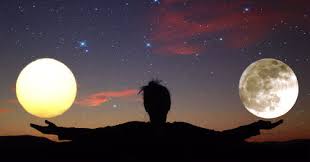
Sun and Moon

Weekly Seven-Day Cycles

The idea of dividing the cycle of the moon into four seven-day weeks may have begun in Babylon. In its familiar modern form, it probably derives from a Jewish model, echoing the story of Creation as told in Genesis, in which God, having made the world in six days, rested on the seventh – and ordered humanity and their animals to do likewise. As a result, every week connects us to the beginning of time itself, as the days plot the round of our work and leisure, the recurrent rhythm of our existence.
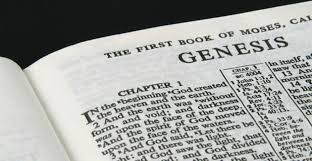
Genesis

Our Language and Beliefs

The weekday names depend on our language and our beliefs. The names that we give the weekdays in English are an inherited meditation on the cycles of time, as we observe the pattern of the sun, the moon and the planets circling above us – though the story they tell us is for English-speakers only, since nobody else’s week is quite the same as ours.


Days Named After Gods

Sunday, Monday – the week begins with the sun and the moon, whose separate movements mark the months and years. After them, come the days of the easily visible planets. In Romance languages, this is Mars, Mercury, Jupiter, and Venus – the sequence that the Romans followed and left behind.

Seven-Planets-of-the-Week

In England, around the seventh century, the planets tethered to the gods of Rome were renamed for the equivalent northern gods, and it is their Anglo-Saxon names – Tiw, Woden, Thor, and Frige – that distinguish the days for English-speakers on Tuesday, Wednesday, Thursday, and Friday. On Saturday, the Anglo-Saxon gods are joined by Saturn, which retained its Latin name, making our week, like our language itself, a peculiar German-Latin hybrid.

Cosmological History

Encompassing the different cycles of sun, moon and the five planets, every week thus implies not just a long span of many years, but also the company of gods and the vastness of space itself. In the names of our days is the entire solar system – the time-space continuum as it was known in the ancient Mediterranean world and transmitted to the north of Europe. The turn of the week is – in English – a concise cosmological history, in which we still live every day with the gods of our ancestors inhabiting an ancient, but stable structure of time.
Living with the Gods
Living With the Gods: On Beliefs and Peoples

Neil MacGregor

Background on Neil MacGregor