Happiness in the Here and Now

It is quite impossible to unite happiness with a yearning for what we don’t have. Happiness has all that it wants, and resembling the well-fed, there shouldn’t be hunger or thirst.

…..EpictetusDiscourses

It’s easy to set conditions for happiness, to tell ourselves: I’ll be happy when’ – tying our happiness to a time down the road when such and such might happen, and thus ruining our chances for happiness here and now.

Instead of yearning for more, better, or someday, we can shine a light on the present – the only place where we can actually experience happiness.

The Daily Stoic
The Daily Stoic: 366 Meditations on Wisdom, Perseverance, and the Art of Living
Ryan Holiday

Background on Epictetus

Hit The Restart Button – Refresh Your Thinking

Restart Life Button

Your principles can’t be extinguished unless you snuff out the thoughts that feed them, for it’s continually in your power to reignite new ones…

It’s possible to start living again! See things anew as you once did – that is how to restart your life!

…..Marcus Aurelius, from Meditations

Marcus Aurelius reminds us that no matter what happens, no matter how disappointing our behavior has been in the past, our principles themselves remain unchanged. We can return and embrace them at any moment. What happened yesterday – what happened five minutes ago – is the past. We can reignite and restart whenever we like.


The Daily Stoic

The Daily Stoic: 366 Meditations on Wisdom, Perseverance, and the Art of Living
Ryan Holiday

Background on Marcus Aurelius

Seeing Life As It Is

Accepting Life

Trying to make a perfect life
is a path of great sorrow.
The perfect life cannot be built
by seeking to fulfill desires
no matter how many years are spent,
or how much effort is applied.
Desires are insatiable and endless.

If instead we see
the imperfect events,
and the ordinary people,
as the movements of the Tao,
life becomes perfect as it is.

The time comes when we realize
that the ducks will never be in a row.
It is the nature of ducks to fly about.
The house will never be perfectly clean.
It is the nature of a house to accommodate clutter.
The project will never be done just right.
It is the nature of projects to evolve
into other
projects.
The future will never be perfectly secure.
It is the nature of life to be unpredictable.

Sit and watch for a moment.
Perfection will be built
from all that is imperfect.

(pages 70 & 71)

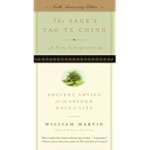
The Sage's Tao Te Ching
The Sage’s Tao Te Ching: Ancient Advice for the Second Half of Life
William Martin


William Martin
William Martin

. Taoist Living
. William Martin (Spirituality & Practice site)
. William C. Martin (his website)

William Martin has been a teacher of Taoism for more than 40 years. He is the author of innovative translations of the Tao Te Ching for specific audiences including parents and couples, as well as books on the Tao and such themes as forgiveness and caring for one another. He continues to think through and write about Taoism, life, and the natural world as well as paint in the Taoist tradition.

Books William Martin has written include:


Opening ‘Pandora’s Box’ – How Mythical References Pervade Our Language

Pandora's Box
Pandora’s curiosity getting the best of her


Cultural & Linguistic Afterlife of Greek Myths

Classical mythology has had an extraordinary linguistic afterlife, giving it an unshakable presence in our common culture. In large part, this is because classical mythology proceeds from concrete stories rather than, as with philosophy, from abstract concepts. This is also why mythology can, even today, address everybody: inspiring children with as much fervor as adults, crossing not only social class and age but also traversing the generations – as it has done virtually without interruption for nearly three millennia.

Many everyday images, figures of speech, and expressions are directly borrowed from Greek mythology without our knowing their meaning or origin. These expressions often bear the memory trace of a mythical or fabulous episode, usually the crisis point in the adventures of a god or hero.

Some of the Many Common Phrases Based on Greek Mythology 

  • to go off in search of the “Golden Fleece”
  • to “take the bull by the horns”
  • to “fall between Scylla and Charybdis”
  • to introduce a “Trojan horse” to our enemies
  • to have an “Achilles’ heel”
  • to feel nostalgia for a “golden age”
  • to look up at the “Milky Way”
  • to take part in the “Olympic” Games
  • to play a “Cassandra”
  • to sink into the “arms of Morpheus”
  • to be blessed – or cursed – with a “Midas touch”
  • to be endowed with “titanic” or “Herculean” strength
  • to stretch on a “Procrustean bed”
  • to embark on a “Promethean” undertaking
  • to open unwittingly a “Pandora’s box”
  • to have a “Oedipus complex”
  • to be a “narcissist”

The Wisdom of the Myths: How Greek Mythology Can Change Your Life

Luc Ferry

Background on Luc Ferry


Greek Mythology – Ancient Wisdom Alive & Well Today

What is Classical Greek Myth? 

Hundreds, if not thousands of books and articles have been devoted to pondering the status of Greek myth: Should it be classified under “tales and legends”, or filed under religion, or placed alongside literature and poetry, or perhaps on the same shelves as politics and sociology?

Greek myth is central to an entire civilization and polytheist religion, but is above all a philosophy in “story form”: a magnificent and concerted attempt to respond in secular form to the question of the good life by means of lessons in wisdom that breathe and live – are clothed in literature, in poetry and epic – rather than formulated in abstract argument. It is this essentially vernacular, poetic, and philosophical cast of Greek myth that accounts for its continuing vitality and involvement for us today – and what renders its singular and precious comparison with the legions of other myths, fairy tales, and legends that, from a strictly literary point of view, might seem to offer competition.

Source of Myths & When They Were Written

We need to remember that this or that “myth” is by no means the work of a single author. There is no original version, no canonical or sacred text comparable with the Bible or Koran, piously preserved through the ages, thereafter carrying authority. On the contrary, we are dealing with a plurality of stories and variants, written down by storytellers, philosophers, poets, and “mythographers” (those who assembled, collated, and edited the various compilations of myths from antiquity onward) over the course of twelve centuries or more: roughly from the seventh century BC to the fifth century AD – not to mention the various oral traditions, of which, by definition, we know comparatively little.

The Wisdom of the Myths: How Greek Mythology Can Change Your Life
Luc Ferry

Background on Luc Ferry