What Can We Learn When Life Interrupts Our Most Cherished Plans?

Life can interrupt our most cherished plans, providing us a reminder that circumstances are indifferent to our ideals and intentions. And, sometimes the circumstances are inside us like buried mines waiting to explode. The main threats to the contented mind come from the mind itself. Enemies within, compulsions we did not know about, because our life did not come with a map of its inner topography enclosed, a guide to its psychic waves.

Leaving Alexandria
Leaving Alexandria: A Memoir of Faith and Doubt

Richard Holloway

Background on Richard Holloway


Houdini’s Magic – The Irresistible Spectacle of Concealment and Deception

Houdini’s fear of being imitated – his need to be unique, unprecedented, unthinkable – was matched by his desire not to imitate himself too much. He was a tireless inventor of things that might defeat him, of traps that could kill him. And all these stunts, as he called them – the word itself meaning a performance, a feat, an event – had that kind of uncanny symbolic resonance that made him an irresistible spectacle, a unique draw in a newly emerging and ever more powerful entertainment industry (Houdini would eventually start his own Film Development Corporation).

Houdini was determinedly and calculatingly a spirit of the age, but by using a vocabulary of familiar cultural objects – chests, trunks, beds, locks, ice (for freezing and preserving food) – he seemed to speak the strange language they seemed to encode, as though the drama of the age was claustrophobia, of the confinement created by new kinds of freedom.

The magic was to escape without damaging the locks, without even chipping the ice. It could all be done without violence, everything would seem the same. The grand illusion was that nothing had changed – neither Houdini nor his box – but everything was different. It was literally a revolution – a radical and irreversible reordering, and a repetition of the same thing unmodified, without apparent struggle. It was magic, an art form in which success was the concealment of difficulty, and the difficulty was deception.

Houdini's Box: The Art of Escape
Houdini’s Box: The Art of Escape
Adam Phillips

Background on Adam Phillips


Harry Houdini
1874-1926

Harry Houdini (born Erik Weisz, later Ehrich Weiss or Harry Weiss) was a Hungarian born American illusionist and stunt performer, noted for his sensational escape acts. He first attracted notice in vaudeville in the US and then as “Harry Handcuff Houdini” on a tour of Europe, where he challenged police forces to keep him locked up. Soon he extended his repertoire to include chains, ropes slung from skyscrapers, straitjackets under water, and having to escape from and hold his breath inside a sealed milk can with water in it.

Houdini died, at age 52, of peritonitis, secondary to a ruptured appendix.

Creativity – Turning Up What is Already There

Creativeness often consists of merely turning up what is already there. Did you know that right and left shoes were thought up only a little more than a century ago?
…..— Bernice Fitz-Gibbon


Bernice Fitz-Gibbon
Bernice Fitz-Gibbon
1894-1982

. AdvertisingAge
. Wikipedia
. Obiturary in The New York Times

Bernice Fitz-Gibbon was an American advertising executive and a pioneer in retail advertising, working at Marshall Field’s, Macy’s, Gimbels and Wanamaker’s. She was inducted into the Advertising Hall of Fame in 1982.

Fitz-Gibbon was the creator of the Macy’s slogan “It’s great to be thrifty” and “Nobody, but nobody, undersells Gimbels.” A former ad manager at Marshall Field’s, Macy’s, Gimbels and Wanamaker, she became retailing’s most important and highly paid advertising director.

She influenced department store and fashion advertising by introducing “events” — fashion shows, dance instruction, lectures, demonstrations, etc. — and chatty, informative eight-column newspaper ads. The award-winning agency she opened in 1954 jump-started copywriter careers for many women.

The Feast of Love – Relationship Stories from Charles Baxter

Relationships, all sorts of relationships, that’s what life’s really all about – whether it be marriage, getting a divorce, having an affair, or living as a single person, each of these situations is interrelated.  And, we endeavor to enter into our relationships with love being the driving force, though sometimes it seems fuzzy to us.

Keep love in your heart. A life without it is like a sunless garden when the flowers are dead.
     —  Oscar Wilde 

Here’s where Charles Baxter’s The Feast of Love comes in, it’s a wonderful, twisting, sensitive, and quirky-comical romp through a series of characters whose lives at first seem disparate, but then begin to intertwine as Baxter unfolds his superb story of love.  The characters are ordinary people – a man who runs a coffee shop, a just out of high school young punker-style boyfriend-girlfriend, an over-sexed female attorney having an affair with a married man, the list goes on  –  who experience the sort of hardships and trials we can all relate to.  Yet, with the deft hand of Baxter, we see beyond the surface of seemingly plain-looking events, and we sense the depth of emotions these people experience.

Since The Feast of Love is the first book I have read by Baxter, I wasn’t familiar with his style of writing.  As I set out to dive into his story, I found myself upset early on, thinking to myself: “What is this guy trying to do?”  I took offense at the liberties Baxter was taking with me, the reader.  First off, he would make rather abrupt narrative changes from one character to another, and that made me do some work to keep up.  Secondly, I became angry at the detail Baxter provided in describing the bedroom activities of those engaging in ongoing affairs.

At times, I was ready to give up and toss the book onto the pile for donation, but I am known to be stubborn, and I managed to stick it out.  It paid off big time, as I learned a lot during my endeavor.  I came away with an understanding of why it made sense for Baxter to unfold his story the way he did.  He was presenting a true-to-life snapshot of life as it really is , with all its rough edges.  And, now, even days after finishing the book, I find myself thinking about some of the characters, and wondering what they would be doing now.
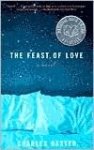
The Feast of Love
The Feast of Love
Charles Baxter

The Feast of Love was a finalist for the 2000 National Book Award for Fiction.


Charles Baxter
Charles Baxter
born 1947

Charles Baxter
. Wikipedia

Charles Baxter was born in Minnesota.  He lives in Minneapolis and teaches at the University of Minnesota. He is the author of eight works of fiction. Although his body of work includes poetry and essays, he is best known for his fiction – brilliantly crafted, non-linear stories that twist and turn in unexpected directions before reaching surprising yet nearly always satisfying conclusions.