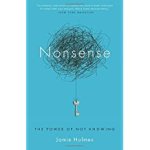
How Do Ambiguity and Uncertainty Attract Us?

The mind state caused by ambiguity is called uncertainty, and it’s an emotional amplifier. It makes anxiety more agonizing, and pleasure especially enjoyable.

The delight of crossword puzzles, for example, comes from pondering and resolving ambiguous clues. Detective stories, among the most successful literary genres of all time, concoct their suspense by sustaining uncertainty about hints and culprits. Mind-bending modern art, the multiplicities of poetry, Lewis Carroll’s riddles, Marquez’s magical realism, Kafka’s existential satire – ambiguity saturates our art forms and masterpieces, suggesting its deeply emotional nature.

Goethe once said that “what we agree with leaves us inactive, but contradiction makes us productive.” So it is with ambiguity.

Nonsense: The Power of Not Knowing

Jamie Holmes

What is Postmodern Philosophy?

In contemporary philosophy, ‘postmodern’ ideas are those which, from the mid-nineteenth century set about dismantling the humanist creed of modernity.

In the same way that the Enlightenment broke with the grand cosmologies of Antiquity and brought about a new critique of religion, so too postmodernity set about demolishing the two strongest convictions of the Moderns from the seventeenth to the nineteenth centuries: the belief that the human is at the center of the modern world – which came to form the basis of all moral and political values; and, the belief that reason is an irresistible force for emancipation.

A Brief History of Thought
A Brief History of Thought: A Philosophical Guide to Living
Luc Ferry


Luc Ferry
Luc Ferry
born 1951

. Wikipedia

Luc Ferry is a French philosopher at the University of Paris, a prolific author, and a notable proponent of secular humanism. From 2002 and until 2004 Ferry served in the French government as the Minister of Education. He lives in Paris.

Ferry has been awarded the Prix Medicis, Prix Jean-Jaques-Rosseau, and Aujourd’hui.

Books Luc Ferry has written include:


What Can We Learn When Life Interrupts Our Most Cherished Plans?

Life can interrupt our most cherished plans, providing us a reminder that circumstances are indifferent to our ideals and intentions. And, sometimes the circumstances are inside us like buried mines waiting to explode. The main threats to the contented mind come from the mind itself. Enemies within, compulsions we did not know about, because our life did not come with a map of its inner topography enclosed, a guide to its psychic waves.

Leaving Alexandria
Leaving Alexandria: A Memoir of Faith and Doubt

Richard Holloway

Background on Richard Holloway


What is the State of Highest Spiritual Concentration?

The state of the highest spiritual concentration, in which every external object has disappeared, is at the same time the state in which one knows the deepest reality.

It is then that “all is so completely present to life that nothing any longer differs from it; such a life is a whole life, the pure and perfect life… It is then that it is sufficient in itself and that it no longer seeks anything.” (Plotinus Enneads V. 3. 16)

The Philosophy of Plotinus
Émile Bréhier

Background on Plotinus


Émile Bréhier
Émile Bréhier
1886-1952

Émile Bréhier was a French philosopher. His interest was in classical philosophy, and the history of philosophy. He wrote a History of Philosophy, translated into English in seven volumes.

Bréhier studied at the University of Paris. In 1908 he received his doctorate at the Sorbonne with a dissertation about Philo of Alexandria. He was Henri Bergson‘s successor at the University of Paris in 1945


What Was the Essence of Ancient Philosophy?

The task of ancient philosophers was to contemplate the cosmic order and its beauty, to live in harmony with it, and to transcend the limitations imposed by sense experience and discursive reasoning. Both Plato and Aristotle traced the origin of philosophy (philosophia, “the love of wisdom”) to wonder.

It was through philosophy, understood as a kind of ascetic exercise or training, that the cultivation of the natural, ethical, civic, purificatory, theoretic, paradigmatic, and hieratic virtues were to be practiced. And, it was through this noetic vision (study of the mind and intellect) that the ancient philosophers tried to awaken the divine light within, and to touch the divine Intellect in the cosmos.

By “philosophizing” ancient philosophers meant both noetic activity and spiritual practice; and, this was attributed not only to various Hellenic philosophers who belonged to different haireseis (Greek term meaning schools or theoretically founded ways of life), but also to the Egyptian priests, Chaldeans, and Indian Gymnosophists.
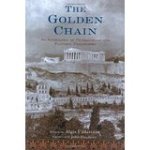
The Golden Chain
The Golden Chain: An Anthology of Pythagorean and Platonic Philosophy
Algis Uzdavinys
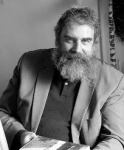


Algis Uzdavinys
Algis Uzdavinys
1962-2010

. Wikipedia


Algis Uždavinys was a prolific Lithuanian philosopher and scholar. His work pioneered the hermeneutical comparative study of Egyptian and Greek religions, especially their esoteric relations to Semitic religions, and in particular the inner aspect of Islam (Sufism). His books have been published in Lithuanian, Russian, English and French.

Uždavinys died in his sleep of an apparent heart attack on July 25, 2010 in his native village of Kabeliai, Lithuania.

Books written By Algis Uzdavinys include: