Desires and Attachments – How Do They Relate?

Desires are a necessary and natural part of life; attachments are an unnecessary source of suffering. Since they are different, desires remain when attachments are relinquished, so we are still motivated to live our lives fully and well. In fact, we are better able to do so, since we are no longer helpless puppets dancing on the strings of compulsive cravings that distort our priorities and lives.

Relinquishing attachments leaves us not apathetic but calm, not joyless but content, not indifferent to others but more concerned and caring. According to Patanjali, who wrote the classic text on yoga two thousand years ago, “When we are established in non-attachment, the nature and purpose of existence is understood.”
Essential Spirituality
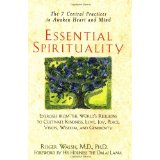
Essential Spirituality: The 7 Central Practices to Awaken Heart and Mind
Roger Walsh

.
.


Roger Walsh
Roger Walsh
Dr. Roger Walsh website, Wikipedia

Roger Walsh (MD, Ph.D.) is an Australian professor of Psychiatry, Philosophy and Anthropology at the University of California, Irvine, in the Department of Psychiatry and Human Behavior, within UCI’s College of Medicine. For over 30 years Walsh has been researching how to enhance well-being — physical, psychological, social and spiritual.  He is married to the psychologist Frances Vaughan, and together they have written a number of books.

Walsh’s broad interests have taken him on a journey covering:  

  • Psychologies such as integral, humanistic, transpersonal, existential, and Asian
  • Transformative practices such as psychotherapy and meditation
  • Religious issues such as shamanism, contemplation, psychedelics, and spiritual practices

Books written by Roger Walsh include:


Roger Walsh — Understanding Religion: Conventional & Postconventional Are VERY Different
Being The Self – Ramana Maharshi’s Wisdom

Even if one occasionally is able to turn their mind away from the world and concentrate it back on the Self, it almost immediately loses its concentration and wanders back to he world. Why does this happen? Ramana said it is because one believes that the world is real. “But for the belief that the world is real, it would be quite easy for you to obtain the revelation of the Self.” The greatest wonder, Ramana declared, is that, being always the Self, one is striving to become the Self.

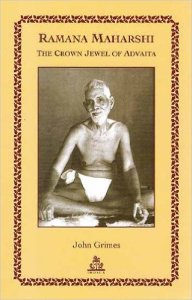
Ramana Maharshi - The Crown Jewel of Advaita
Ramana Maharshi: The Crown Jewel of Advaita
John Grimes


Ramana Maharshi
Ramana Maharshi 
1879-1950

Sri Ramana
Sri Ramana Maharshi ashram
Wikipedia
Teachings of Ramana Maharshi

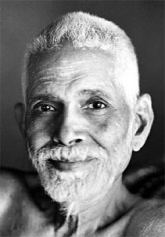
Ramana Maharsi was probably the most famous sage of the twentieth century both in India and the rest of the world.

Ramana Maharshi was a sage and jivanmukta (one who, in the Advaita Vedanta philosophy of Hinduism, has gained and assimilated self-knowledge, thus is liberated with an inner sense of freedom while living). He was born Venkataraman Iyer, in Tiruchuli, Tamil Nadu, South India, and given the name Bhagavan Sri Ramana Maharshi in 1907, by one of his first devotees — the name struck and remains that by which he is widely known.

In 1896, at the age of 16, he became aware that “his real nature was formless, immanent consciousness,” resulting in a state which he later described as enlightenment. Six weeks later he left his family home in Madurai, and journeyed to the holy mountain Arunachala, in Tiruvannamalai,  South India, where he remained for the rest of his life.

Although his first years in Tiruvannamalai were spent in solitude, he soon attracted devotees, and in later years a community grew up around him. Although worshipped by thousands, he never received private gifts, and treated all with equal respect. Since the 1930s his teachings have been popularized in the west.

Throughout the years, Ramana Maharshi responded to many questions on spiritual matters, but always insisted that silence was the purest teaching.  In response to questions on self-liberation and the classic texts on Yoga and Vedanta, Ramana recommended self-enquiry as the principal way to awaken to “I-I”, thereby realizing the Self and attaining liberation. He also recommended Bhakti, as well as giving his approval to a variety of paths and practices.


How Can We Transform Painful Emotions?

Something in the American character does not like patience. A culture of ambition makes it difficult for us to hold still. Patience seems to put a damper on the spontaneity and freedom we so cherish. A consumer society’s dependence on impulse buying and the media’s accommodation to short attention spans do not foster the development of patience.

Befriending painful emotions demands patience. Patience prepares us to lead our lives wide awake, to taste our negative emotions rather than simply swallowing our pain. The disciplines of patience transform our painful emotions into positive passions for life.

Transforming Our Painful Emotions
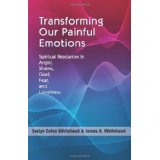
Transforming Our Painful Emotions: Spiritual Resources in Anger, Shame, Grief, Fear, and Loneliness
Evelyn Eaton Whitehead & James D. Whitehead

The book is a psychological and spiritual exploration of the positive potential hidden in our painful emotions, showing how so-called bad feelings can be good news.


James and Evelyn Whitehead

Evelyn & James Whitehead

James and Evelyn Whitehead have been long associated with the Institute of Pastoral Studies at Loyola University Chicago, where they regularly offer academic courses and short workshops. They have coauthored a dozen books which have been translated into several languages.

James Whitehead is a historian of religion with a concentration in pastoral reflection and the links between virtue and moral emotions. Evelyn Whitehead is a developmental psychologist with a special interest in the connections between psychological growth and spiritual maturing in adult life.

The Whiteheads also provide programs at various university and other educational settings throughout the United States and internationally.


World Religion Truth Claims – Acceptance By Others

In the past, great movements of religious expansion such as those of Buddhism, Christianity, and Islam did involve contact among followers of different religions; however, such contact for the most part represented conflicts rather than dialogues. It is only during the past few centuries that such contact has stimulated inquiry into the actual beliefs and practices of various religions in a less combative atmosphere and has brought home to an increasing number of us the problem of the conflicting truth claims made by different religious traditions.

Although this may be true globally, it seems that India had to face the issue of religious pluralism — and that of the conflicting truth claims inherent in such a situation — at least as far back as the sixth century B.C.E. Conflicting truth claims were certainly an element in the situation Indian thinkers had to reckon with.

Philosophy of Religion and Advaite Vedanta
The Philosophy of Religion and Advaita Vedanta: A Comparative Study in Religion and Reason
Arvind Sharma


Arvind Sharma
Arvind Sharma (Dr. Arvind Sharma website, wikipedia)
born 1940

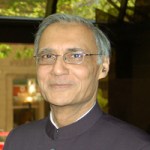
Arvind Sharma is the Birks Professor of Comparative Religion at McGill University. His works focus on comparative religion, Hinduism, and the role of women in religion.

Sharma was the first Infinity Foundation Visiting professor of Indic Studies at Harvard. He has held fellowships at the John F. Kennedy School of Government, the Center for the Study of World Religions, the Brookings Institution, the Center for the Study of Values in Public Life, and the Center for Business and Government. He was also elected a Fellow of the Royal Asiatic Society.

Sharma writes two blogs: Indological Provocations and The Comparative Study of Religion.


Books written by Arvind Sharma include: