Aloneness, Silence, and the Inner Life

Aloneness Begins in Puzzlement

Aloneness begins in puzzlement at our own reflection, transits through awkwardness and even ugliness at what we see, and culminates, one appointed hour or day, in a beautiful unlooked for surprise, at the new complexion beginning to form, the slow knitting together of an inner life, now exposed to air and light.

Inhabiting Silence

To inhabit silence in our aloneness is to stop telling the story altogether. To begin with, aloneness always leads to rawness and vulnerability, to a fearful simplicity, to not recognizing and to not knowing, to the wish to find any company other than that not knowing, unknown self, looking back at us in the silent mirror.

Our Own Way of Being Alone

The permeability of being alone asks us to re-imagine ourselves, to become impatient with ourselves, to tire of the same old story and then slowly hour by hour, to start to tell the story in a different way as other parallel ears, ones we were previously unaware of, begin to listen to us more carefully in the silence. For a solitary life to flourish, even if it is only for a few precious hours, aloneness asks us to make a friend of silence, and just as importantly, to inhabit that silence in our own particular way, to find our own way into our own particular and even virtuoso way of being alone.
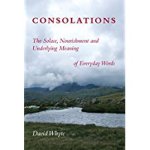
Consolations
Consolations: The Solace, Nourishment and Underlying Meaning of Everyday Words
David Whyte

.


David Whyte
David Whyte
born 1955

. David Whyte (website)
. Poetry Foundation
. Wikipedia

David Whyte is an English poet and philosopher. His poetry is known for its eclectic and spiritual bent.

Whyte was born and raised in Yorkshire; his mother was Irish and his father English. He earned a degree in marine biology in Wales and for a time led naturalist tours and expeditions in the Galapagos Islands, the Andes, the Amazon region, and the Himalayas. He shared a deep friendship with the late Irish philosopher John O’Donohue.

Whyte is an Associate Fellow at Saïd Business School at the University of Oxford. He has worked with a variety of international companies and in 2008 was awarded an honorary doctorate from Neumann College, Pennsylvania. He currently lives in the Pacific Northwest.

Whyte is quoted as saying that all of his poetry and philosophy is based on “the conversational nature of reality”.

Books written by David Whyte include:

Recordings by David Whyte include:


Start Close In – David Whyte

.
On Belonging and Coming Home – David Whyte
How Can We Experience True Joy & Tranquility?

In his essay On the Happy Life, the Stoic philosopher Seneca explains how best to pursue tranquility. Basically, we need to use our reasoning ability to drive away “all that excites us or affrights us.” If we can do this, there will ensue “unbroken tranquility and enduring freedom,” and we will experience “a boundless joy that is firm and unalterable.” Seneca claims that someone who practices Stoic principles “must, whether he wills or not, necessarily be attended by constant cheerfulness and a joy that is deep and issues from deep within, since he finds in his own resources, and desires no joys greater than his inner joys.” Furthermore, compared to these joys, pleasures of the flesh are “paltry and trivial and fleeting.”

The tranquility Seneca and other Stoics sought is not the kind of tranquility that might be brought on by ingestion of a tranquilizer – it is not, in other words, a zombie-like state. Stoic tranquility is, instead, a state marked by the absence of negative emotions such as anger, grief, anxiety, and fear, and the presence of positive emotions – in particular, joy.

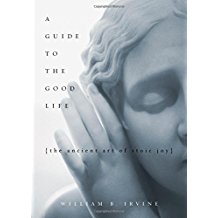
A Guide to the Good Life: The Ancient Art of Stoic Joy


A Guide to the Good Life: The Ancient Art of Joy

William B. Irvine

Background on William B. Irvine

Background on Seneca


What Does the History of Morality Tell Us About Humanity?

What can the history of morality tell us about the nature of morality? And, what can it tell us about ourselves as human beings?

Morality is like a map guiding us from the way humans are to the way we think humans ought to be. It is, however, a most unusual kind of map. Most maps help you locate the starting point of the journey and the destination, and pinpoint the route that can take you from one to the other. Not so in the case of morality. On the moral map the starting point, the destination, and the route are all created during the journey itself.

The story of morality is the story of how the relationship between these two visions of the human – the relationship between how we might imagine humans are and how we envision they can be – has changed over time and across space, from Homer’s Greece to Mao’s China, from ancient India to modern America.

Our understanding of what it is to be human, of human nature, has changed over time. Additionally, what it is to be human only makes sense in light of our conception of the kind of beings we want to be, and the kind of world we want to live in.

To look upon morality as a historical product is not to degrade it, but, rather to breathe life into it – to understand morality as a human creation, to recognize it not as a fixed monument but as an evolving story. History becomes a tool through which to discover that values have changed, and why, and what it tells us about our moral lives today.

When we look upon morality as a historical product, it allows us to ask questions such as these:

  • Why were ancient Greek gods so immoral?
  • How did China manage, for more than two millennia, to create a strong ethical framework without the need for God?
  • Why did caste became so important in India?
  • Why did Augustine, one of the greatest Christian theologians, think slavery and torture were morally acceptable?
  • Why was the Europe of the Enlightenment (18th century) also the Europe of imperial terror?
  • How are contemporary claims that science can define moral norms an echo of the religious idea that values derive from God?

A historical account might undermine the idea of moral injunctions as absolute and objective, but it also reveals new ways to think of moral norms as more than merely a matter of personal preference or political need.

The Quest For Moral A Compass: A Global History of Ethics
The Quest for a Moral Compass: A Global History of Ethics
Kenan Malik


Kenan Malik
Kenan Malik
born 1960

. Kenan Malik (website)
. Pandemonium (website)
. Wikipedia

Kenan Malik is an Indian-born British writer, lecturer and broadcaster, trained in neurobiology and the history of science. As a scientific author, his focus is on the philosophy of biology, and contemporary theories of multiculturalismpluralism and race.

Malik has given lectures or seminars at a number of universities, including: Cambridge; Oxford; Institute of Historical Research, London; University of Oslo; and the European University Institute, Florence. In 2003, he was a visiting fellow at the University of Melbourne. He is currently Senior Visiting Fellow at the University of Surrey.

Malik has been a presenter and panelist on the BBC radio programs Analysis, Night Waves, and Moral Waves. He has written and presented a number of TV documentaries, including Disunited Kingdom (2003), Are Muslims Hated? (which was shortlisted for the Index on Censorship Freedom of Expression award, in 2005), Let ‘Em All In (2005) and Britain’s Tribal Tensions (2006). ‘Strange Fruit’ was longlisted for the Royal Society Science Book Prize in 2009.

Books written by Kenan Malik include:


Happiness Can Be Found Only Within

Freedom is the only worthy goal in life. It is won by disregarding the things that lie beyond your control. We cannot have a light heart if our minds are a woeful cauldron of fear and ambition.

Do you wish to be invincible? Then don’t enter into combat with what you have no real control over. Your happiness depends on three things, all of which are within your power: your will, your ideas concerning the events in which you are involved, and the use you make of your ideas.

Authentic happiness is always independent of external conditions. Vigilantly practice indifference to external conditions. Your happiness can only be found within.

How easily dazzled and deceived we are by eloquence, job title, degrees, high honors, fancy possessions, expensive clothing, or a suave demeanor. Don’t make the mistake of assuming that celebrities, public figures, political leaders, the wealthy, or people with great intellectual or artistic gifts are necessarily happy. To do so is to be bewildered by appearances and will only make you doubt yourself.

Remember: The real essence of good is found only within things under your control. If you keep this in mind, you won’t find yourself feeling falsely envious or forlorn, pitifully comparing yourself and your accomplishments with others.

Stop aspiring to be anyone other than your own best self: for that does fall within your control.

Art of Living
Art of Living: The Classical Manual on Virtue, Happiness, and Effectiveness
Epictetus

A New Interpretation by Sharron Lebell

Sharon Lebell is a philosophical writer and musician who lives in Northern California. She also produced Epictetus’s A Manual for Living.


Epictetus
Epictetus

50-135CE

. Internet Encyclodedia of Philosophy
. Stanford Encyclopedia of Philosophy
. Wikipedia

Epictetus was a Greek Stoic philosopher. He was born a slave at HierapolisPhrygia (present day Pamukkale, Turkey) and lived & taught in Rome until 94CE, when Emperor Domitian banished philosophers from the city. Epictetus went to Nicopolis in northwestern Greece for the rest of his life. In exile, he established a school of philosophy where his distinguished students included Marcus Aurelius

Epictetus taught that philosophy is a way of life and not just a theoretical discipline. To Epictetus, all external events are beyond our control; we should accept calmly and dispassionately whatever happens. However, individuals are responsible for their own actions, which they can examine and control through rigorous self-discipline.

Epictetus’s chief concerns are with integrity, self-management, and personal freedom. Heartfelt and satirical by turns, his lucid resystematization and challenging application of Stoic ethics qualify him as an important philosopher in his own right.

In 1988, the writer Tom Wolfe revived Stoic philosophy in the bestselling novel A Man in Full.

Books by Epictetus include:


Finding Joy Through Living the Stoic Way of Life

The Truth About Stoicism

There is a common misperception about Stoicism. For example, the dictionary defines a stoic as “one who is seemingly indifferent to or unaffected by joy, grief, pleasure, or pain” – such a definition gives the impression that Stoics would be emotionally repressed individuals. Yet, the goal of the Stoics was not to banish emotion from life, but to banish negative emotions.

When reading the works of the Stoics, you encounter individuals who were cheerful and optimistic about life; were fully capable of enjoying life’s pleasures; and, valued joy, tranquility, and virtue.

Inner Joy of Stoics

For Seneca, what Stoics seek to discover is how the mind may always pursue a steady and favorable course, may be well-disposed towards itself, and may view its conditions with joy. (On Tranquility)

Seneca also asserts that someone who practices Stoic principles must, whether he wills it or not, necessarily be attended by constant cheerfulness and joy that is deep and issues from deep within, since he finds delight in his own resources, and desires no joys greater than his inner joys. (On the Happy Life)

Similarly, the Stoic philosopher Musonius Rufus tells us that if we live in accordance with Stoic principles, a cheerful disposition and secure joy will automatically follow.

Active Lifestyle of Stoics

Rather than being passive individuals who were grimly resigned to being on the receiving end of the world’s abuse and injustice, the Stoics were fully engaged in life and worked hard to make it a better place.

Examples of Stoics actively engaged in life:

  • Cato the Younger
    While a practicing Stoic, Cato fought bravely to restore the Roman republic. Seneca referred to Cato as the perfect Stoic.
  • Seneca
    Along with being a Stoic philosopher, Seneca was a successful playwright, an advisor to an emperor, and the first-century equivalent to being an investment banker.
  • Marcus Aurelius
    Besides being a Stoic philosopher, he was a Roman emperor – arguably one of the greatest Roman emperors.

A Guide to the Good Life: The Ancient Art of Stoic Joy
A Guide to the Good Life: The Ancient Art of Joy
William B. Irvine

Irvine plumbs the wisdom of Stoic philosophy, one of the most popular and successful schools of thought in ancient Rome, and shows how its insight and advice are still remarkably applicable to modern lives. He shows readers how to become thoughtful observers of their own lives.

If we watch ourselves as we go about our daily business and later reflect on what we saw, we can better identify the sources of distress and eventually avoid that pain in our life. By doing this, the Stoics thought, we can hope to attain a truly joyful life.


William B. Irvine
William B. Irvine
born 1952

. William B. Irvine (literary website)
. A Guide to the Good Life Interview (Daily Stoic)
. A Guide to the Good Life (YouTube)

William B. Irvine is a Professor of Philosophy at Wright State University in Dayton, Ohio. Along with teaching, Irvine is an author and practices Stoicism as a way of life.

Books William B. Irvine has written include: