Christ the Redeemer

Christ the Redeemer

Christ the Redeemer is a symbol of Brazilian Christianity. The statue has become an icon for Rio de Janeiro and Brazil.

The statue depicts Jesus Christ overlooking Rio de Janeiro, Brazil, on the peak of the 2,300 foot Corcovado mountain in the Tijuca Forest National Park.

Christ the Redeemer is massive:

  • 98 feet tall, not including its 26 foot-high pedestal
  • arms stretch 92 feet wide
  • weighs 718,000 pounds
  • made of reinforced concrete and soapstone
  • constructed between 1922 and 1931

The statue was created by French sculptor Paul Landowski.


Modern Man is Secular

Modern Man is a secular Man, which does not mean that he is not religious or that he has lost his sense of the sacred. The statement means only that his religiousness and even any sense of sacredness he may possess are both tinged with a secular attitude. “Secular attitude” means a particular temporal awareness that invests time with a positive and real character: the temporal world is seen as important and the temporal play of Man’s life and human interactions is taken seriously; the saeculum, the ayas, is in the foreground. Man can survive on earth, both as a species and as a person, only if he pays careful attention to everything secular. Otherwise he will be swallowed up by the machinery of modern society or the mechanism of cosmic processes. Secular Man is the citizen of the temporal world.
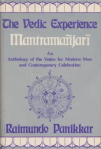
The Vedic Experience
The Vedic Experience: Mantramanjari
Raimon Panikkar

.

.

Raimon Panikkar says in the Introduction:

This anthology aims at presenting the Vedas as a human experience that is still valid and capable of enriching and challenging modern Man, as he seeks to fulfill his responsibility in an age in which, for better or worse, he is inseparably linked with his fellows and can no longer afford to live in isolation.


An abridged version of The Vedic Experience: Mantramanjari, called simply The Vedic Experience, and written by Ramion Panikkar, is available for free download.

“Myside” Bias

“Myside Bias” is our tendency to continue thinking in ways that favor our current views. Once we adopt an opinion or reach a conclusion, we tend to seek out evidence that supports our point of view, while ignoring or dismissing evidence to the contrary.

Character Strengths and Virtues
Christopher Peterson and Martin Seligman


Letting Go of Our Viewpoints

In order to see the whole universe we have to get out of the universe. But this is impossible. We are already in the world. We are already standing on a certain point, and we see only part of the world each time. Our picture of the world is a kind of fantasy made of our memory in our brain. Each person has this limitation. That is why we have problems, troubles, fighting, arguments. The angles we see the world from are different and the supreme awareness is to see that we cannot see the whole world, to understand that we are deluded and limited. This means we have to let go of our viewpoints. Only when we are doing this are we free from the limitations of our individuality.

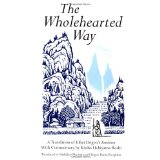
The Wholehearted Way
Eihei Dogen’s Bendowa


God as Creativity

We should not allow ancient religious assumptions and beliefs to lead us into thinking we know or understand what happens in events or processes such as the biblical account of creation. God, of course, has always been understood to be a profound mystery, but the way in which God has been talked about has often involved fudging this point and proceeding as though we knew that God is really a personal being, one of enormous power who can create at will things that previously did not exist. Thinking of God as creativity (rather than as “the Creator”) forces us to take the profundity of God’s mystery to a deeper level. For “creativity” is simply a name with which we identify this profound mystery of new realities coming into being; it is in no way an explanation of it.

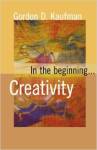
In the beginning Creativity
In the beginning…Creativity
Gordon Kaufman