Can We Experience Divine Love?

Divine love has no conditions. We are invited into it not as an abstract idea or as a ritual only, but as an experience. Contemplation is the experience of God that is becoming continuous and permanent even in the details of everyday life and amid the distractions of computers and the ghastly reports of the horrors of violence throughout the world. The divine goodness and the presence of divine love are always there. As our contemplative clarity deepens, we move from the occasional experience of the Presence to a permanent state of loving interaction on a moment by moment basis.
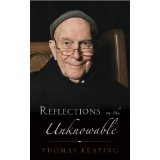
Reflections on the Unknowable
Thomas Keating

This brief text, only 168 pages long, is a  distillation of over 70 years as a monastic and more than 30 years writing on centering prayer.
.

.


Thomas Keating
Thomas Keating
born 1923

Wikipedia
Spirituality & Practice
Contemplative Outreach
What is Centering Prayer?

Thomas Keating was born on March 7, 1923. He is a Trappist monk and priest. Keating is one of the foremost teachers of contemplative prayer in the Christian tradition. He is one of the founders of the Centering Prayer movement. The roots of Centering Prayer go back to the 4th century Desert Fathers. Keating also started Contemplative Outreach, Ltd.  He attended Deerfield Academy, Yale University, and Fordham University, graduating in December 1943.

Keating has presented the Centering Prayer method and its related mystical theology to gatherings of non-Christians, Protestants, and Roman Catholics worldwide. He has also taken this ministry to seminarians, priests, lay people, and prisoners. Keating also frequently participates in dialogues with contemplatives of other religions.


Books by Thomas Keating include:

Audio by Thomas Keating include:


Thomas Keating – Oneness & The Heart of the World

.

Thomas Keating – Buddha at the Gas Pump Interview

.

Thomas Keating – The Method of Centering Prayer

 

To Penetrate Our Cosmic Past, We Need To “Get Out Of The Box”

Some truths are mathematically outside the reach of the human brain, despite its abilities. As pure mathematics has shown us, some propositions cannot be proved or disproved from within a given system. They require a way of getting “outside the box” in order to gain information about them that could lead to a proof or disproof of an assertion.

Our inherent inability to penetrate our cosmic past to a level that could get us back to the Big Bang and whatever caused it may be our main stumbling block on the way to understanding where we came from, why we came here, where we are going, and who or what made us. In any logical system there are unprovable  assertions, and the question of God may well be one of these unknowns — forever to remain outside our reach.

Why Science Does Not Disprove God
Amir D. Aczel

Benefits of Living Mindfully

To live mindfully… is to bring greater awareness to each activity, to be more present to each moment, and to catch subtle experiences that all too often go unnoticed.

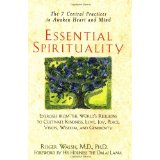
Essential Spirituality
Essential Spirituality: The 7 Central Practices to Awaken Heart and Mind
Roger Walsh
.

.
.


.Mindfulness Has Five Benefits

  1. Interpersonal Sensitivity
    Mindfulness makes us more present to each person we meet, more aware of the other person’s feelings and many messages conveyed by subtle body movements and vocal tones. This allows us to attune to their motives and emotions and to be more empathic with their feelings.
    .
    Empathy is the ability to share another person’s feelings. Empathy is an especially crucial skill, and research shows that meditation is one of the few methods known to enhance it.
    .
  2. Refining the Senses
    There is much talk in spiritual circles about giving up sensory pleasures, but much of this discussion is superficial and mistaken.We don’t necessarily need to give up sensory pleasures, but we do need to give up our attachment to them. Sooner or later any attachment causes suffering, and sensory attachments are no exception. Free of craving, we can enjoy our pleasures without fear or worry.We also need to refine the senses by honoring each experience and bringing to it a careful, gentle, and penetrating awareness or mindfulness.
    .
    Refined Senses Offer Three Major Gifts
    1) They enhance the appreciation and pleasure of each moment.
    2) Because each experience is more rich and satisfying, there is less craving for more experiences. The appreciation of quality experiences replaces the raw hunger for quantity — the glutton becomes a gourmet.
    3) Refining the senses is an excellent mental training that fosters beneficial qualities such as concentration and calm.
    .
  3. Knowing One’s Mind
    As awareness matures, it is able to observe not only the outer but also the inner world with increasing precision. Much that was formerly unconscious becomes conscious. Making the unconscious conscious has been the essence of meditation for thousands of years, and meditative awareness can penetrate far below the levels of psychotherapy.
    .
  4.  Freedom from Automaticity
    Awareness can break the chain of dependent origination in the instant after a crisis. This deconditions and weakens the habits of craving and aversion, and thereby liberates us from our own conditioning.
    .
  5. The Healing Power of Awareness
    Mindfulness heals. Many of the unhealthy and self-destructive things we do spring from automatic, unconscious responses. We feel anxious and find ourselves smoking, feel lonely and suddenly realize we’ve finished a box of chocolates, feel hurt by a casual remark and damage a friendship by lashing back automatically. These responses are born of mindlessness and can be prevented by mindfulness.
    .
    Mindfulness allow us to guard the mind. To be mindful and guard the mind means we are aware as we reach for a cigarette, chocolate, or harsh word and can therefore choose whether to continue or to make a different response.

Be always mindful of what you are doing and thinking. So that you may put the imprint of your immortality on every passing incident of your daily life.

     Abd’l-Khaliq Ghijdewani, 13th century Sufi

Do One Thing At A Time

Living Our Modern Lives, We Want to Do Multiple Things at Once…

Our frantic minds reflect our frantic lives as we try to fit more and more into each day. We constantly do two or more things at a time. We dress while listening to the radio; prepare a meal while planning our day; then eat the meal while reading the paper and watching television. We listen to the radio while driving and at work talk on the telephone while preparing a report. Our lives feel fragmented, our minds are agitated, blood pressure is raised, and our attention span is shortened.

Thomas Merton, one of the twentieth century’s most influential Christians, summarized the dilemma we face:

The rush and pressure of modern life are a form, perhaps the most common form, of its innate violence. To allow oneself to be carried away by a multitude of conflicting concerns, to surrender to too many demands, to commit oneself to too many projects, to want to help everyone in everything is to succumb to violence. The frenzy of the activist neutralizes his or her work for peace.

Essential Spirituality
Essential Spirituality: The 7 Central Practices to Awaken Heart and Mind
Roger Walsh

How Can We Heal The Past?

Guidelines for Healing the Past

  • Undo any damage. If you caused pain or harm, it is wise to undo it wherever possible. For example, if you hurt someone’s  feelings, you may want to apologize; if you stole something, it may be appropriate and healing to replace it or pay for it.
  • Aim for solutions in which everyone wins. The ideal solution is one in which everyone involved gains and learns from the process. For example, if someone hurt you, it is far better to gently explain that the behavior was hurtful than it is to attack. Ideally, both of you will learn from and be healed by the interaction.
  • Avoid attack. It is terribly tempting to retaliate when someone hurts you. The painful result, however, is usually only a dizzying spiral of ever-increasing anger, attack, and counterattack.
  • Communicate. Simply telling someone honestly and openly about your pain can be remarkably healing. This kind of communication is so effective that it forms the basis of the healing offered by religious confession, psychotherapy, and self-help groups such as Alcoholics Anonymous.
  • Learn. As always, learn as much as possible from your experience. For example, when you have resolved a dilemma, see what worked and what didn’t, so you can proceed more effectively in the future.


Essential Spirituality
Essential Spirituality: The 7 Central Practices to Awaken Heart and Mind
Roger Walsh