How Did The Days Of The Week Get Their Names?

Sun and Moon

Weekly Seven-Day Cycles

The idea of dividing the cycle of the moon into four seven-day weeks may have begun in Babylon. In its familiar modern form, it probably derives from a Jewish model, echoing the story of Creation as told in Genesis, in which God, having made the world in six days, rested on the seventh – and ordered humanity and their animals to do likewise. As a result, every week connects us to the beginning of time itself, as the days plot the round of our work and leisure, the recurrent rhythm of our existence.

Genesis

Our Language and Beliefs

The weekday names depend on our language and our beliefs. The names that we give the weekdays in English are an inherited meditation on the cycles of time, as we observe the pattern of the sun, the moon and the planets circling above us – though the story they tell us is for English-speakers only, since nobody else’s week is quite the same as ours.


Days Named After Gods

Sunday, Monday – the week begins with the sun and the moon, whose separate movements mark the months and years. After them, come the days of the easily visible planets. In Romance languages, this is Mars, Mercury, Jupiter, and Venus – the sequence that the Romans followed and left behind.

Seven-Planets-of-the-Week

In England, around the seventh century, the planets tethered to the gods of Rome were renamed for the equivalent northern gods, and it is their Anglo-Saxon names – Tiw, Woden, Thor, and Frige – that distinguish the days for English-speakers on Tuesday, Wednesday, Thursday, and Friday. On Saturday, the Anglo-Saxon gods are joined by Saturn, which retained its Latin name, making our week, like our language itself, a peculiar German-Latin hybrid.

Cosmological History

Encompassing the different cycles of sun, moon and the five planets, every week thus implies not just a long span of many years, but also the company of gods and the vastness of space itself. In the names of our days is the entire solar system – the time-space continuum as it was known in the ancient Mediterranean world and transmitted to the north of Europe. The turn of the week is – in English – a concise cosmological history, in which we still live every day with the gods of our ancestors inhabiting an ancient, but stable structure of time.
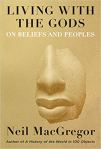
Living with the Gods
Living With the Gods: On Beliefs and Peoples

Neil MacGregor

Background on Neil MacGregor

How Many Atoms Are In The Human Body?

Inside Human Body

Looking Into a Mirror

Standing in front of a full-length mirror, you can look at your whole body, viewing it as a single remarkable object – a living creature. But you can also dig into details, exploring the ways your body interacts with the world around it, or how it makes use of the energy in the food you eat to get you moving.

Number of Cells in a Body

Zoom in further and you will find somewhere between 10-100 trillion cells. Each cell is a sophisticated package of life, yet taken alone, a cell certainly isn’t you. Go further still and you will find complex chemistry abounding – you have a copy of the largest known molecule in most of your body’s cells: the DNA  in chromosome 1.

Number of Atoms in a Body

Continue to look in even greater detail and eventually you will reach the atoms that make up all matter. Here traditional numbers become clumsy – a typical adult is made up of around 7, 000, 000, 000, 000, 000, 000, 000, 000, 000 atoms. It’s much easier to use scientific notation to denote the number of atoms in a human body: 7 x 10 27 atoms, meaning 7 with 27 zeroes after it.

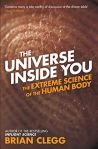
The Universe Inside You
The Universe Inside You: The Extreme Science of the Human Body

Brian Clegg


Brian Clegg
Brian Clegg
born 1955

. Brian Clegg website
. Wikipedia

Brian Clegg is an English science writer. Clegg is the author of popular science books on topics including light, infinity, quantum entanglement, and surviving the impact of climate change.

Books Brian Clegg has written include:

Meditation – Being Present & Aware

Meditation

Settling Down

Sitting in meditation is one of the best ways to allow the mind and body to settle down.

The intention, when sitting in stillness and silence, is to be as fully present as possible with whatever we are experiencing. The point is not to feel calm, although this certainly might happen as the mind and body settle. The point is to be aware, and to cultivate the ability to reside in what is.

Being Present

The path of meditation implores us to do the simplest yet most difficult thing – to sit still and just be present, to reflect without thinking. There is no action involved, only stillness and observation.

Watching What Comes Up

In meditation we let whatever comes up, come up. We invite it in. We welcome all of it, including the resistance, boredom, the judgments, and the endless mental spinning. We let it come up and then we watch it. We don’t think, we don’t analyze, we don’t judge –  we simply watch and experience.

When things come up that we don’t like, we try to remember that thoughts and feelings are our teachers – we can learn from them. They’re not an enemy to conquer or get away from. So, we don’t try to change our experience, we just remain in a state of awareness.

Acknowledging Who We Are 

We watch with curiosity as our experience unfolds, without trying to make ourselves different. Doing this means we’ll no longer have to live out of our cherished self-images, such as being a calm, or “together” person. In other words, we don’t have to hang onto looking “spiritual.” Instead, we can just acknowledge who we are – including all our shortcomings. We can give up our ideals of perfection.


Beyond Happiness: The Zen Way to True Contentment

Ezra Bayda

Background on Ezra Bayda

How Can We Develop Mental Strength?

Mentally Strong

13 Things Mentally Strong People Don’t Do

  1. Don’t waste time feeling sorry for yourself.
  2. Don’t give away your power.
  3. Don’t shy away from change.
  4. Don’t focus on things you can’t control.
  5. Don’t worry about pleasing everyone.
  6. Don’t fear taking calculated risks.
  7. Don’t dwell on the past.
  8. Don’t make the same mistakes over and over.
  9. Don’t resent other people’s success.
  10. Don’t give up after the first failure.
  11. Don’t fear alone time.
  12. Don’t feel the world owes you anything.
  13. Don’t expect immediate results.

Getting rid of these 13 habits will help us develop mental strength, which is essential to dealing with all of life’s problems – big or small.

No matter what our goals are, we’ll be better equipped to reach our full potential when we’re feeling mentally strong.

13 Things Mentally Strong People Don't Do
13 Things Mentally Strong People Don’t Do: Take Back Your Power, Embrace Change, Face Your Fears, and Train Your Brain for Happiness and Success
Amy Morin

Background on Amy Morin

Suffering And The Feeling Of Not Being Whole

Suffering Alone
Source of Suffering

The root of suffering – the real root of all our problems – is in the mind. That means the place we can address our problems is also in the mind.

Feeling of Not Being Whole

So many of our problems arise because we feel cut off from something we need. We do not feel whole and therefore turn expectantly toward other people for the qualities we imagine missing in ourselves. All of the problems of the world, from one person’s anxiety to warfare between nations, can be traced to this feeling of not being whole.

The Truly Rich Person

The truly rich person is the one who has a satisfied mind. The affluence of satisfaction comes from wisdom, not from external things. If you are truly free from the mind of attachment, you’ll see that nothing really belongs to you in the first place.

When the Chocolate Runs Out: Mindfulness & Happiness

Lama Thubten Yeshe

Background on Lama Thubten Yeshe