

Enlightenment isn’t something we march toward, and one day, somehow, we grab it. Enlightenment is the ending in yourself of that hope for something other than life being as it is.
Charlotte Joko Beck
Ordinary Wonder
Charlotte Joko Beck

Enlightenment isn’t something we march toward, and one day, somehow, we grab it. Enlightenment is the ending in yourself of that hope for something other than life being as it is.
Charlotte Joko Beck
Ordinary Wonder
Charlotte Joko Beck

Pervasiveness of Laughter
Laughter has been considered one of the primitive emotions recognized in every culture. Of all the different emotional expressions, laughter is one of the few that adults who have been deaf and blind from birth can generate. Although we all have moments of solitary experience, laughter is predominantly a social phenomenon that has its roots both in early human development and also early in the development of our species.
Thinking of Others
We like to laugh and make others laugh. Not only does laughter have a multitude of benefits in terms of coping with stress and illness, but it works to bind individuals together in social coalitions. It is a deeply emotional response activated by the emotional regions of the amygdala and associated with brain networks, but it operates in conjunction with higher-order processes related to social cognition — thinking about others.
The Self Illusion: How the Social Brain Creates Identity
Bruce Hood

Living Mindfully
Paying attention to what you are doing right now is mindfulness. Just breathing — that’s mindfulness! Just walking — that’s mindfulness! Just eating — that’s mindfulness! In mindfulness is relaxation. How many moments in our life have we lived mindfully? The more moments we can count, the more relaxed we will likely feel.
The One-Minute Meditator: Relieving Stress and Finding Meaning in Everyday Life
David Nichol and Bill Birchard

Inquiring Into Sensations
If we don’t inquire into our sensations we might perceive them as unbearably intense, and presume they will continue to be so for a long time. However, if we do inquire into our sensations, we soon notice their evanescent nature.
Realizing Changes
Sensations differ from second to second, and they might disappear entirely within minutes. The realization sensations come and go will allow us to break our tendency to assume that things are more lasting and painful than they could ever be.
Daily Wisdom
Edited by Josh Bartok

The Cave Story
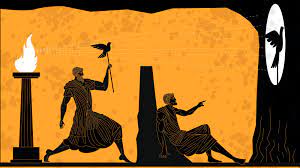
Plato (c. 428-348 BCE) believed that only philosophers understand what the world is really like. Philosophers discover the nature of reality by thinking rather than relying on their senses. To make this point, Plato described a cave.
Inside an imaginary cave there are people chained, facing a wall. In front of them they can see flickering shadows made by objects held up in front of a fire that’s behind them. These people spend their entire lives thinking that the shadows projected on the wall are the real world.
Then, one of the people breaks free from his chains and turns toward the fire. His eyes are blurry at first, but then he starts to see where he is. He stumbles out of the cave and eventually is able to look at the sun. When he comes back to the cave, no one believes what he tells them about the world outside the cave.
The man who broke free is like a philosopher. He sees beyond appearances. Ordinary people, on the other hand, have little idea about reality because they are content with looking at what’s in front of them, rather than thinking about it deeply — but the appearances are deceptive since what are seen are shadows, not reality.
A Little History of Philosophy
Nigel Warburton
 Who Knows Anyhow?