
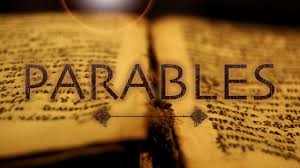
Default World vs. Parable World
The default world is the world of procedural knowledge. It is composed of what we commonly accept, see, and operate in as the world at hand. Procedural knowledge is the assumed knowledge used daily in the default world. The parable world, however, is the world in contrast to the default world, and the knowledge needed to understand a parable is counter-intuitive to procedural knowledge.
Parables and the Anonymous Self
When reading a parable, we must necessarily free ourselves of procedural knowledge, but the most difficult part of this insight involves recognizing that procedural knowledge includes the habitual way we think about the self. To enter the parable world, I must overcome assumptions I hold about myself – assumptions such as my self-importance, my fixed identity, and my preoccupations with self-satisfaction. The act of getting into the parable world begins with seeing my self as a social construct. The self is my identity. It is constructed from my status in society: the amount of money I have, the class I belong to, the influence my status gives to my decisions, the reasons people know or want to know about me (or avoid me), the level of self-esteem gained in relationships with others or within social systems that become vital to the self because they signify to the self the importance (place, position, power) of the self.
In the world of procedural knowledge, the self can win or lose, can hold status or shame, can be satisfied or disappointed. The default world consists of the interactivity of the desires and the social positions of human selves. Yet, in the parable world, there is no self. Or, another way to imagine it, in relation to itself the self in parable is an anonymous self, a self without a name. The self in parable is not self-important or self-centered; it is not a self in need of a system of meaning to signify importance to itself.
The no-name self of the parable, the self that is anonymous to itself, is one that accepts itself merely and miraculously as a location of awareness, as a “happenstance” as the philosopher/theologian Don Cupitt says, born out of the history of coincidental human relationships on our planet. The anonymous self sees the fabrication of relationships that create default reality and can pierce through the fabric with a liberty of consciousness that accepts the self as a host of the coincidental history of relationships that have produced this one location of awareness. The anonymous self is a self that accepts itself anonymously as a location of awareness.
Clutching and grabbing, so essential to winning in the default world, are a loss in the parable world of the anonymous self. In the parable world, I celebrate winning by losing, gaining by letting go. In the default world, winning and losing create or harm my self-esteem, but in the parable world winning and losing are exactly what need to be pierced to in order to be free. In the parable world, there is no such thing as the power of God or the favor of God for a worldly, historical figure. These things in the parable are seen as the way the default world hides its emptiness from itself. They are the lights and the sound of importance that, in parable, distract from the joyfulness of authentic life. Indeed, in parable, ironically, the sounds of importance are the least important thing. When the values of success in the default world become that for which I clutch and grab, the “I” of myself has lost the parable’s gift of anonymity; the default reality has become who I am and how I think. In the world I may have won, but in parable I have lost.
To be in the “counter-intuitive” world of the parable is to be an “anonymous self,” a self who is not the consequent result of clutching and grabbing after life. In parable, everything in the world that is and that can be is already part of the whole story. Everything that is in the world is already the consequence of the total relationship of things that compose the world. Nothing exists in isolation; nothing is self-created; everything in this sense is anonymous, that is, without singular identity or without an absolute name.
Parables of Jesus – Liberation for the Possible
The quest to find a stable identity is not the point of the parables of Jesus. One’s name or occupation is no privilege. Of course, we need names and identities in order to build societies and to advance learning, but in the parable the emptiness of these default necessities is exposed in the larger vision of anonymity. Every “thing” in parable breaks across the line of singular identity to the other side of anonymity, where it can play host to a world liberated from the status quo. A vineyard worker who strains all day crosses over to anonymity when his co-worker who strains less than an hour is paid the same wage. The older brother of the prodigal son crosses over to anonymity when he cares less about his inheritance and joins the celebration of his younger brother’s return. In parable, the promise is that the world can be differently arranged and differently reasoned because its current default form is only one set of possibilities within an infinite set of possibilities. Parable is liberation for the possible.

Embracing the Human Jesus: A Wisdom Path for Contemporary Christianity
David Galston

David Galston
David Galston is the Executive Director of the Westar Institute and the Ecumenical Chaplain at Brock University in St. Catharines, Ontario, where he is also an Adjunct Professor of Philosophy. He has a PhD in the Philosophy of Religion from McGill University.
Galston is a co-founder and Academic Advisor of the SnowStar Institute of Religion, a Fellow of the Jesus Seminar, and a United Church minister. David has written several articles and led many workshops on the question of the historical Jesus, the future of Christianity, and the problems of Christian theology in light of the historical Jesus.
Books written by David Galston include:
- Archives and the Event of God: The Impact of Michel Foucault on Philosophical Theology
- Embracing the Human Jesus: A Wisdom Path for Contemporary Christianity
- God’s Human Future: The Struggle to Define Theology Today

 Who Knows Anyhow?