
What you are, the world is.
And without your transformation, there can be no transformation of the world.— Krishnamurti

Total Freedom: The Essential Krishnamurti
…..Krishnamurti
……. J. Krishnamurti
……. Wikipedia
What you are, the world is.
And without your transformation, there can be no transformation of the world.— Krishnamurti
Total Freedom: The Essential Krishnamurti
…..Krishnamurti
……. J. Krishnamurti
……. Wikipedia
The way you can go
isn’t the real way.
The name you can say
isn’t the real name.Heaven and earth
begin in the unnamed:
name’s the mother
of the ten thousand things.So the unwanting soul
sees what’s hidden,
and the ever-wanting soul
sees only what it wants.Two things, one origin
but different name,
Mystery of all mysteries!
The door to the hidden.…..Tao Te Ching
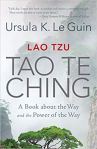
Lao Tzu: Tao Te Ching: A Book about the Way and the Power of the Way
Ursula K. Le Guin
….. Ursula K. Le Guin website
….. Wikipedia
The Tao Te Ching was probably written about 2,500 years ago by a man called Lao Tzu, who may have lived at about the same time as Confucius. Nothing about it is certain except that it’s Chinese, any very old, and speaks to people everywhere as if it had been written yesterday.
The Tao Te Ching is partly prose, partly verse; but not as we define poetry now, not by rhyme and meter but as patterned intensity of language, the whole thing is poetry. I wanted to catch the poetry, its terse, strange beauty. Most translations have caught meanings in their net, but prosily, letting the beauty slip through. And in poetry, beauty is no ornament; it is meaning. It is the truth… I wanted a Book of the Way accessible to a present-day… perhaps un-male reader, not seeking esoteric secrets, but listening for a voice that speaks to the soul.
…..Ursula K. Le Guin

Life is Painful
There is a lot of pain in human life. Sometimes our pain is caused by an outside tragedy, such as difficult circumstances we go through. Sometimes events shake our world to its core. Other times we feel internal and emotional pain – which we are all very vulnerable to.
The Pain of Separation
The sense of being human, of being a person, is also painful because we feel a separation between ourselves and others, a separation between ourselves and the world. As long as this sense of fundamental separation continues in our consciousness, there is always going to be pain, pain that we cannot really describe – it is an existential pain. This pain also causes loneliness that can be deeper than just longing for companionship.
Healing Through Transcendence
The pain of this loneliness won’t go away by trying to fill our inner vacuum through acquiring external comforts. It can, however, be healed through what might be called true transcendence, which is the goal of many spiritual traditions, even many that don’t accept each other’s doctrines. True transcendence is the experience that we are no longer trapped in the narrow realm of the ego.
There is a part of us that longs to experience transcendence. Transcendence gives us the sense that all of our problems are gone. It is the sense that somehow we are one with everything. We don’t have to be spiritual to have this longing for transcendence. It is a universal longing.

Choosing Compassion: How to Be of Benefit in a World That Needs Our Love
Anam Thubten
Background on Anam Thubten

Prose Narratives
Myths, legends, and folktales are narratives in prose – referred to as prose narratives. This distinguishes them from proverbs, riddles, ballads, poems, and other verbal forms.
Myths
Myths are prose narratives which, in the society in which they are told, are considered to be truthful accounts of what happened in the remote past.
Characteristics of Myths
Legends
Legends are prose narratives which, like myths, are regarded as true by the narrator and his audience, but they are set in a period considered less remote, when the world was much as it is today.
Characteristics of Legends
Folktales
Folktales are prose narratives which are regarded as fiction.
Characteristics of Folktales

Sacred Narrative: Readings in the Theory of Myth
Edited by Alan Dundes

Meaning of Pantheism
The word Pantheism derives from the Greek words pan (all) and theos (God). Literally, Pantheism means All is God. In essence, Pantheism holds that the Universe as a whole is worthy of the deepest reverence, and that only the Universe and Nature are worthy of that degree of reverence.
Nature and Unity
The statement “Nature is my god” is perhaps the simplest way of summarizing the core pantheist belief, with the word “god” meaning not a supernatural being, but the object of deepest reverence.
Pantheism is a spiritual path that reveres and cares for nature – a spiritual path that accepts this life as our only life, and this earth as our only paradise. Pantheism revels in the beauty of nature and the night sky, and is full of wonder at their mystery and power.
Pantheism believes that all things are linked in a profound unity. All have a common origin and destiny. All things are interconnected and interdependent. In life and death, humans are an inseparable part of this unity, and in realizing this we can find our joy and peace.
History of Pantheism
Pantheism is among the oldest religious beliefs. It can be dated back to at least the 6th or 7th centuries BC, when the Hindu Upanishads were written, and the Greek philosopher Hericlitus lived. Pantheism, of one kind or another, came to dominate the ancient world, East and West.
The spread of Christianity and Islam forced Pantheism underground for around 1200 years, but by the 19th century it was beginning to regain some of its old prominence. It was the dominant belief of many philosophers and poets, including Wordsworth, Goethe, Hegel, and Walt Whitman.
The wars and ideologies of the 20th century pushed Pantheism to the background again, but today Pantheism is having a renaissance in Scientific Pantheism, nature-oriented Paganism, Deep Ecology, philosophical Taoism, Zen Buddhism, and forms of Humanism that are open to spirituality.

Elements of Pantheism: A Spirituality of Nature and the Universe
 Who Knows Anyhow?