Forgiveness – Healing Our Past & Shaping Our Future

Forgiveness is a skill, a way of preserving clarity, sanity and generosity in an individual life, a beautiful way of shaping the mind to a future we want for ourselves; an admittance that if forgiveness comes through understanding, and if understanding is just a matter of time and application then we might as well begin forgiving right at the beginning of any drama rather than put ourselves through the full cycle of festering, incapacitation, reluctant healing and eventual blessing,

To forgive is to put oneself in a larger gravitational field of experience than the one that first seemed to  hurt us. We reimagine ourselves in the light of our maturity and we reimagine the past in the light of our new identity, we allow ourselves to be gifted by a story larger than the story that first hurt us and left us bereft.

At the end of life, the wish to be forgiven is ultimately the chief desire of almost every human being. In refusing to wait; in extending forgiveness to others now, we begin the long journey of becoming the person who will be large enough, able enough and generous enough to receive, at the very end, that absolution ourselves.

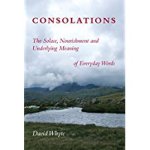
Consolations
Consolations: The Solace, Nourishment and Underlying Meaning of Everyday Words
David Whyte

Background on David Whyte

How is Goodness Key to Living Ethically?

We can understand that no norms can tell us exactly what to do once we are out in the messy world, juggling myriad roles and emotions and scenarios. The only norm is goodness. For Confucius, cultivating and expressing goodness are the only ways to become an ethical person.

(Goodness means: moral excellence; virtue; kindness; generosity.)

The Path
The Path: What Chinese Philosophers Can Teach Us About the Good Life

Michael Puett and Christine Gross-Loh

Background on Michael Puett and Christine Gross-Loh

Background on Confucius


Let Virtue Shine Bright

Does the light of a lamp shine and keep its glow until its fuel is spent? Why shouldn’t your truth, justice, and self-control shine until you are extinguished?

…..Marcus Aurelius, from Meditations

The light of reason suffuses the universe. Whether the wick of your lamp is being lit for the first time, or after a long period of darkness, it makes no difference.

Here is where you are right now, and it’s the best place to let virtue shine and continue to shine for as long as you exist.

The Daily Stoic
The Daily Stoic: 366 Meditations on Wisdom, Perseverance, and the Art of Living

Ryan Holiday

Background on Marcus Aurelius


How Are You Living Your Life On a Daily Basis?

A Deceptively Profound Question

Philosophers generally jump right in with big questions such as: Do we have a free will? What is the meaning of life? Is experience objective? What is morality?

Confucius, however, took the opposite approach in his teachings. Rather than start with the great big philosophical questions, he asked this fundamental and deceptively profound question:

How are you living your life on a daily basis?

For Confucius, everything begins with this question – a question about the tiniest things. And unlike the big, unwieldy questions, this is one we all can answer.

Confucius – China’s First Great Philosopher

Confucius, who lived from 551 to 479 BC, was the first great philosopher in the Chinese tradition. His vast and enduring influence comes not from grand ideas, but from deceptively simple ones – ideas that flip on its head everything we understand about getting to know ourselves and getting along with other people.

The Analects, a collection of conversations and stories compiled by disciples of Confucius after his death, is full of concrete, minute details about what Confucius did and what he said. We see how he talks to different people when he walks into a room. We learn, in specific detail, how Confucius behaves at dinnertime.

You might wonder how any of this could be of philosophical significance. You might be tempted to flip through the Analects for yourself and search for passages where Confucius says something really profound. But to understand what makes the Analects a great philosophical work, we need to know what he did on a daily basis.

The reason these daily moments are important is because they are the means through which we can become different and better human beings.

The Path
The Path: What Chinese Philosophers Can Teach Us About the Good Life
Michael Puett and Christine Gross-Loh

The Path is being published in more than 25 countries.
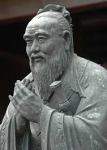

Confucius
Confucius

551-479BC

. Internet Encyclopedia of Philosophy
. Stanford Encyclopedia of Philosophy
. Wikipedia

Confucius was a Chinese teacher, editor, politician, and philosopher of the Spring and Autumn period of Chinese history.

The philosophy of Confucius, also known as Confucianism, emphasized personal and governmental morality, correctness of social relationships, justice and sincerity. He is traditionally credited with having authored or edited many of the Chinese classic texts including all of the Five Classics, but modern scholars are cautious of attributing specific assertions to Confucius himself. Many years after his death, aphorisms concerning his teachings were compiled in the Analects.

Confucius’s principles had a basis in common Chinese tradition and belief. He championed strong family loyalty, ancestor veneration, and respect of elders by their children and of husbands by their wives, recommending family as a basis for ideal government. He espoused the well-known principle “Do not do to others what you do not want done to yourself”, the Golden Rule.

Confucius is widely considered as one of the most important and influential individuals in affecting the lives of humanity. His teaching and philosophy greatly impacted people around the world and still linger in today’s society.


Michael Pruett
Michael Pruett

. Harvard Bio & Publications

Michael Puett is the Walter C. Klein Professor of Chinese History and Anthropology, as well as the Chair of the Committee on the Study of Religion, at Harvard University. He is the recipient of a Harvard College Professorship for excellence in undergraduate teaching.

Pruett’s interests are focused on the inter-relations between philosophy, anthropology, history, and religion, with the hope of bringing the study of China into larger historical and comparative frameworks.

Christine Gross-Loh
Christine Gross-Loh

Christine Gross-Loh (website)

Christine Gross-Loh is a journalist and author. She writes on history, education, philosophy, and global parenting and has been published in the Wall Street Journal, the Atlantic, the Guardian, and Vox. She has a BA from Bryn Mawr College and a PhD from Harvard University in East Asian history.

Books written by Michael Pruett include:

Books written by Christine Gross-Loh include:

How Does the Movement of Language Shape Our World?

Culture is a system of signs inscribed upon us as we learn our mother tongue. Current linguistic usages carry our values and prescribe the way we see the world. Society creates your world through you.

The endlessly fertile metaphoricity of language, the mobility and the unpindownableness of words, mean we are caught up in language, as in a ferment and flux. The movement of language is never wholly predictable or controllable.

Distinctions between fact and interpretation, truth and fiction, largely disappear. We are still language-programmed, but not in any rigid or deterministic way. Language and the world have become too shifting and fluid for that. We have come to the age of cinema, and of the magic-realist and postmodern novel. ‘Reality’ has become a magical illusion that continually shifts, changes and renews itself.

We dream the dream and it dreams us, so we can dance with it.

Creation Out of Nothing
Don Cupitt


Don Cupitt
Don Cupitt
born 1934

Don Cupitt is an English philosopher of religion and scholar of Christian theology. He has been an Anglican priest and a professor of the University of Cambridge, though is better known as a popular writer, broadcaster and commentator.  Cupitt has written 40 books—which have been translated into Dutch, Persian, Polish, Korean, Portuguese, Danish, German and Chinese.

Outside the Western tradition, Cupitt has looked mainly to Buddhism. Of his recent books, Emptiness and Brightness is the most Buddhist. He is a friend of Stephen Batchelor, who is sometimes described as his counterpart within Buddhism.

Eighteen of Cupitt’s recent books have been translated into Chinese. The reason for this move to the East is that, whereas in the West Cupitt is read mainly in Theology faculties and is therefore regarded as heretical, in China he is read as Philosophy and gets a much fairer hearing. Thus for Cupitt there is, paradoxically, more religious freedom in China than in the West. He is seen as writing somewhere between Christianity, Buddhism and French-style postmodernism, and his present religion of “solar” commitment to ordinary life makes sense to many people in China, which has never been much attracted to other-worldy, dogmatic religion.

Cupitt came to the British public’s attention in 1984 with his BBC television series The Sea of Faith, in which orthodox Christian beliefs were challenged. He is currently a key figure in the Sea of Faith Network, a group of spiritual “explorers” (based in the United Kingdom, New Zealand and Australia) who share Cupitt’s concerns.

Books written by Don Cupitt include:


Sea of Faith BBC Documentary, Six Part Series – Written and Narrated by Don Cupitt

Sea of Faith – Part 1 (Galileo, Descartes, Pascal) – Don Cupitt

Sea of Faith – Part 2 (Freud, Jung, Darwin, William Smith) – Don Cupitt

Sea of Faith – Part 3 (David Friedrich Strauss, Albert Schweitzer) – Don Cupitt

Sea of Faith – Part 4 (Marx, Kierkegaard )- Don Cupitt

Sea of Faith – Part 5 (Schopenhauer, Vivekananda, Annie Besant) – Don Cupitt

Sea of Faith – Part 6 (Nietzsche, Wittgenstein)- Don Cupitt