Mary Magdalene & The Gospel Of Philip

There are three important new source materials for the study of Mary Magdalene: the Gospel of Thomas & the Gospel of Philip (both from the Nag Hammadi collection); and, the Gospel of Mary Magdalene (not from Nag Hammadi, but from Cairo). Of these three works, the Gospel of Philip is the most ornate & intricate. 

The Gospel of Philip is essentially tantric in orientation (centered in the transformation of eros), but as in all tantric teaching, prudence and spiritual subtlety are required to catch the real meaning. This is the Gospel in which Mary Magdalene appears the most undisguised as Jesus’ companion and beloved… But in this gospel even more than in most, it is dangerous to pull lines out of context in an effort to glean personal information. The whole gospel unfolds as a single tapestry around the theme of bridal mysticism as the core metaphor for the Christian path.


The Meaning of Mary Magdalene
Cynthia Bourgeault

Was Early Christianity Pluralistic?

Contrary to the Roman Catholic story of unbroken transmission of church doctrine, the real origin of Christianity is far more fascinating and believable. Rather than an unadulterated “pure doctrine” handed on from apostle to apostle, early Christianity was a melting pot of pluralism, as different in ethnicity and temperament as the Mediterranean lands themselves. 

There were Jewish Christians, Greek Christians, Roman Christians, a whole line of Syrian and Aramaic Christians that has largely dropped out of sight, initiates of Mystery schools, keepers of the Torah, millennialists and mystics, misogynists, and matriarchs. Each community struggled within the terms of its own frame of understanding to make sense of the Jesus event, and within each community that vision looked a little different.

Far from bowing to some objective standard of orthodoxy, what gave these early Christian communities their seat-of-the-pants dynamism was that everything had to be worked out from scratch. What did Jesus actually teach? Who was an apostle and who wasn’t? How did one tell? Needless to say, there were many local options, and the texts that circulated among these early outposts of Christians comprised an ongoing conversation rather than an unbroken monologue. 


The Meaning of Mary Magdalene 
Cynthia Bourgeault 

Where Can Happiness Be Found?

The Enlightenment declared the conviction that the goal of life was happiness, and that if this goal could be attained at all, it was to be found in the here and now, despite the manifold imperfections of earthly life.


The Enlightenment: The Pursuit of Happiness 1680-1790
Ritchie Robertson

How Did Zoroastrianism Affect Religion In The Ancient Near East?

Evil in the World

At a significant point in the religious evolution of the ancient Near East, God gained an enemy in the Devil. A major value of the concept of the Devil is its ability to explain evil in the world.

Persians Conquer Babylon

During the Exile, when Babylon which had once again conquered the Israelites and exiled the upper classes to Mesopotamia, the Persians conquered Babylon. The Persians were a thoroughly foreign, Indo-European culture that brought a wholly new understanding of the divine to the Semitic Israelites.

Zoroastrianism

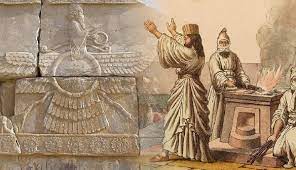
Zoroastrians had been present in Persian culture hundreds of years before Persia expanded into Mesopotamia. The basic position of Zoroastrianism was that God was opposed by a near equal but opposite being, the Devil. One early form of that theological dualism claimed that at the beginning there was but the One, the single God alone who contained all there is — all opposites, all things good and evil. This one God then emanated two roots, the Holy Spirit and the Devil, who were destined to fight each other for a predetermined number of ages until the battle was won.


The River of God
Gregory Riley