Seeing The True Nature Of Being

True reality is hidden by the practice of thoughts
but also in the denial.
Accept the reality of not naming things
and rest in the silence of being.

The need to name, the need to distinguish
are born of a clinging fear.
Remain unattached to every thought
and know the true nature of being.

The Book of Nothing
The Book of Nothing: A Song of Enlightenment
(original Chinese title: Hsin Hsin Ming)
Sosan
S

.
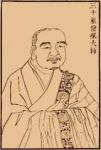

Sosan
Sosan
died 606

Sosan was the third patriarch of the Zen tradition of Buddhism. Sosan is the Japanese translation of the Chinese name Seng T’san (also known as Sengcan). Not much is known about Sosan, though he was a layman. His short work, The Book of Nothing (just 80 pages of poetry), is an inspiration to seekers of many traditions. The Book of Nothing succinctly, and very simply, captures the essence of the empty mind that in the generations following Sosan was to be the hallmark of the Zen tradition.

The empty mind, or no-mind, loosely describes the state in which reality is experienced directly without being filtered through the thought process of the mind. Without this filter, reality is experienced as completely fresh, radiant, and luminous — and, as if for the first time. Inherent in this experience is a feeling of both joy and bliss.

Like Bodhidharma (first patriarch) and Huike (second patriarch) before him, Sosan was reputed to be a devotee and specialist in the study of the Lankavatara Sutra, which taught the primacy of consciousness, the elimination of all duality, and the “forgetting of words and thoughts.”

An online collection of Sosan’s works is available at Terebess Asia Online.
The Heart of Existentialism

The refusal to belong to any school of thought, the repudiation of the adequacy of any body of beliefs whatever, and especially of systems, and a marked dissatisfaction with traditional philosophy as superficial, academic, and remote — that is the heart of existentialism.

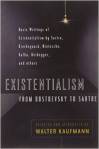
Existentialism from Dostoevsky to Sarte
Existentialism from Dostoevsky to Sartre

Walter Kaufmman
.
.

.


Some Key Existential Philosophers

Kierkegaard-Dostoyevsky-Nietzsche-Sartre -- Existential Philosophers

.
From left to right, top to bottom: Søren Kierkegaard, Fyodor Dostoevsky, Friedrich NietzscheJean-Paul Sartre


Seventh Principle of Biocentrism – Space is a Projection From Our Mind

Space is a Projection from Within Our Minds

Biocentrism shows that space is a projection from inside our minds, where experience begins. Space is not a physical phenomenon per se — and should not be studied in the same way as chemicals and moving particles. Our modern finding is that seeming emptiness seethes with an almost unimaginable energy, which manifests as virtual particles of physical matter, jumping in and out of reality like trained fleas. The seemingly empty matrix upon which the storybook of reality is set is actually a living, animated “field,” a powerful entity that is anything but empty.

We have multiple illusions and processes that routinely impart a false view of space. Shall we count the ways?

  1. Empty space is not empty.
  2. Distances between objects can and do mutate depending on a multitude of conditions, so that no bedrock distance exists anywhere, between anything and anything else.
  3. Quantum theory casts serious doubt about whether even distant individual items are truly separated at all.
  4. We “see” separations between objects only because we have been conditioned and trained, through language and convention, to draw boundaries.

By treating space as something physical, existing in itself, science imparts a completely wrong starting point for investigations into the nature of reality, or in the current obsession with trying to create a Grand Unified Theory that truly explains the cosmos.


There are 7 Principles of Biocentrism, all of which are built on established science, and all of which demand a rethinking of the physical universe.

Seventh Principle of Biocentrism: Space, like time, is not an object or a thing. Space is another form of our animal understanding and does not have an independent reality. We carry space and time around with us like turtles with shells. Thus, there is no absolute self-existing matrix in which events occur independent of life.

Biocentrism
Biocentrism: How Life and Consciousness are the Keys to Understanding the True Nature of the Universe

Robert Lanza, MD
with Bob Berman

Do You Have The Faith Of A Heretic?

Heresy is a set of opinions “at variance with established or generally received principles.” In this sense, heresy is the price of all originality and innovation.

In theology, any “opinion that is contrary to the fundamental doctrine or creed of any particular church” is heretical. From the point of view of churches to which we do not belong – and none of us can belong to the lot – we are all heretics.

For centuries heretics have been persecuted by men of strong faiths who hated non-conformity and heresy and criticism. In our time, millions have been murdered in cold blood by foes of non-conformity and heresy and criticism.

The Faith of a Heretic

Walter Kaufmann


Republished in June 2015 (originally published in 1959), The Faith of a Heretic is Walter Kaufmann’s most personal statement of his beliefs. He also provides the fullest account of his views on religion. Although he considered himself a heretic, he was not immune to the wellsprings and impulses from which religion originates, declaring it among the most vital and radical expressions of the human mind.

The book covers a lot of ground, touching on theology, organized religion, morality, suffering, and death – all examined from the perspective of a “quest for honesty.” Kaufmann also subjects philosophy’s faith in truth, reason, and absolute morality to the same heretical treatment. Four words summarize this book: engaging, provocative, refreshing, rewarding.


Walter Kaufmann
Walter Kaufmann
1921-1980

Walter Kaufmann was a German-American philosopher, translator, and poet. He was a professor at Princeton University for over 30 years. Kaufmann was a prolific author, and wrote extensively on a broad range of subjects, including: authenticity and death, moral philosophy and existentialism, theism and atheism, Christianity and Judaism, as well as philosophy and literature. He is renowned as a scholar and translator of Nietzsche.

Internet resources for Walter Kaufmann:

Books written by Walter Kaufmann include:

Complete list of books & articles written by Walter Kaufmann.


Walter Kaufmann Discusses Existentialism (Part 1 of 2)


Walter Kaufmann Discusses Existentialism (Part 2 of 2)


Sixth Principle of Biocentrism – Time is Our Perception

Time Does Not Exist Outside of Perception

People accept that time exists as a physical entity because we have invented those objects called clocks, which are simply more rhythmic and consistent than budding flowers or apples rotting. In reality what’s happening is motion, pure and simple — and this motion is ultimately confined to the here and now. Everything prior to this moment is the past, gone forever. But this subjective feeling of living on the edge of time is a persistent illusion, a trick of our attempts to create an intelligible organizational pattern for nature in which one calendar day follows upon another, that spring precedes summer, and that years pass. Time in a biocentric universe is not sequential — however much our habitual perceptions dictate that it is.

Science has no real explanation why we’re alive now, existing on the edge of time. According to the current physiocentric worldview, it’s just an accident, a one-in-a-gaziollion chance that we are alive.

From a biocentric point of view, time does not exist in the universe independent of life that notices it, and really doesn’t truly exist within the context of life either.


There are 7 Principles of Biocentrism, all of which are built on established science, and all of which demand a rethinking of the physical universe.

Sixth Principle of Biocentrism: Time does not have a real existence outside of animal-sense perception. It is the process by which we perceive change in the universe.

Biocentrism
Biocentrism: How Life and Consciousness are the Keys to Understanding the True Nature of the Universe

Robert Lanza, MD
with Bob Berman