
The twentieth century saw more millions slaughtered than during the previous history of the human race.

Theology for Pilgrims
Nicholas Lash
The twentieth century saw more millions slaughtered than during the previous history of the human race.
Theology for Pilgrims
Nicholas Lash
We accept authority because we discover some point in the world at which we accept the lordship of something not ourselves. We do not worship authority but we accept authority as defining the worshipful.

New Essays in Philosophical Theology
Alasdair MacIntyre & Antony Flew, editors
When it comes to consciousness, nothing allows us to deduce the properties of subjective experience — the redness of red, the bitterness of regret, the warmth of fire — from the mass, momentum, spin, charge, or any other property of subatomic particles bouncing around in the brain. This is the hard problem of consciousness.

Why Materialism Is Baloney: How True Skeptics Know There Is No Death and Fathom Answers to life, the Universe, and Everything
Bernardo Kastrup
In the past, great movements of religious expansion such as those of Buddhism, Christianity, and Islam did involve contact among followers of different religions; however, such contact for the most part represented conflicts rather than dialogues. It is only during the past few centuries that such contact has stimulated inquiry into the actual beliefs and practices of various religions in a less combative atmosphere and has brought home to an increasing number of us the problem of the conflicting truth claims made by different religious traditions.
Although this may be true globally, it seems that India had to face the issue of religious pluralism — and that of the conflicting truth claims inherent in such a situation — at least as far back as the sixth century B.C.E. Conflicting truth claims were certainly an element in the situation Indian thinkers had to reckon with.

The Philosophy of Religion and Advaita Vedanta: A Comparative Study in Religion and Reason
Arvind Sharma
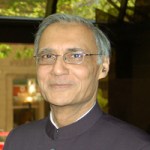
Arvind Sharma (Dr. Arvind Sharma website, wikipedia)
born 1940
Arvind Sharma is the Birks Professor of Comparative Religion at McGill University. His works focus on comparative religion, Hinduism, and the role of women in religion.
Sharma was the first Infinity Foundation Visiting professor of Indic Studies at Harvard. He has held fellowships at the John F. Kennedy School of Government, the Center for the Study of World Religions, the Brookings Institution, the Center for the Study of Values in Public Life, and the Center for Business and Government. He was also elected a Fellow of the Royal Asiatic Society.
Sharma writes two blogs: Indological Provocations and The Comparative Study of Religion.
Books written by Arvind Sharma include:
There is indeed no ‘hard problem’: the brain is in no way fundamentally distinct from mind. But instead of meaning that mind is nothing but the brain, what this means is that the brain is nothing but mind! It is mind that is the broader framework, encompassing the brain but also the rest of existence. Our heads are in mind, not mind in our heads. The brain is merely an image in mind of a process of mind.
Why Materialism Is Baloney: How True Skeptics Know There Is No Death and Fathom Answers to life, the Universe, and Everything
Bernardo Kastrup
.
.
.
Bernardo Kastrup has a Ph.D. in Computer Engineering with specializations in artificial intelligence and reconfigurable computing. Kastrup has worked as a scientist in some of the world’s foremost research laboratories, including the European Organization for Nuclear Research (CERN). He is a successful entrepreneur and currently works in the high-tech industry. He writes about metaphysics and philosophy of mind.
Kastrup maintains a website called Bernardo Kastrup’s Metaphysical Speculations.
Books written by Bernardo Kastrup include:
Bernardo Kastrup — Why Materialism Is Baloney

 Who Knows Anyhow?