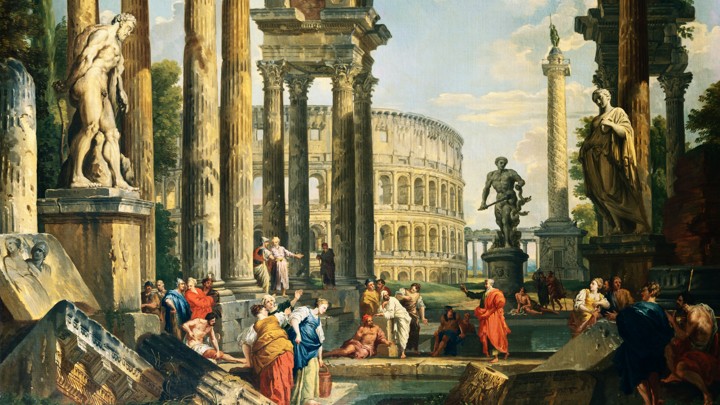
What Did “Pagan” Mean In Ancient Rome?

Ancient Rome

Evolution of the Term “Pagan”

The word pagan itself only began to circulate widely in the 370s AD. It was a word used in a religious sense only by Latin Christians. And, Hellenes, meaning followers of the religion of the ancient Greeks, was the term used by Greek Christians.

Originally, pagan had nothing to do with religion. The term pagan is derived from paganus, a Latin word, which originally meant a mere civilian – a person who did not enjoy the honors and prestige attached to service of the emperor. Christians used the term to brand those who did not serve the true emperor, Christ. Such persons (pagans) were outsiders – they were not fully enrolled members of the empire of God.

Pagan was not necessarily a hate word. It was often used in a relatively neutral manner as a convenient, idiomatic term for non-Christians.

Was Symmachus a Pagan?

Quintus Aurelius Symmachus (345-402 AD), better known simply as Symmachuswas a Roman statesman, orator, and man of letters. He sought to preserve the traditional religions of Rome at a time when the aristocracy was converting to Christianity. He “worshipped the gods” as he had always done.

Symmachus was the first person of Roman nobility who was forced to adjust to what amounted to an unprecedented situation. He was being labeled by others in confessional terms as a pagan, yet it wasn’t a label he would have chosen for himself. He did not see his fellow Romans (Christians or non-Christians) as divided between insiders and outsiders in this sectarian manner.

Whatever their beliefs, Symmachus wished to treat members of his class as peers held together by Rome’s old-fashioned “religion of friendship.” Symmachus was neither inert nor oblivious to the world in which he lived. He simply had better things to do than apply religious labels to his friends and colleagues.

Being Aware of Historical Trends

When considering how use of the term pagan evolved, it can be seen that we moderns are the heirs of what originally were novel Christian attitudes, which only became fully public in the 370s and 380s AD.

Through the Eye of a Needle
Through the Eye of a Needle: Wealth, the Fall of Rome, and the Making of Christianity in the West, 350-550 AD

Peter Brown


Peter Brown
Peter Brown
Born 1935

Peter Brown is Rollins Professor of History Emeritus at Princeton University. He is credited with having brought coherence to the field of Late Antiquity, and is sometimes regarded as the inventor of the field.

Brown’s work has concerned, in particular, the religious culture of the later Roman Empire and early medieval Europe, and the relation between religion and society. He is a prolific author and editor, and has won prizes in the field of ancient history.

Books Peter Brown has written include:

Is Love Our Most Basic Instinct?

Love

Love is Part of Everyone

Love is innate to all of us. We can regard love along with intelligence, compassion, and courage as our basic instincts. Our basic instincts are not all dark and impure.

There is love in all of us. There is universal love, all-embracing love, in all of us. Love is part of who we are.

Love Has Many Forms

There are many forms of love. Love comes in a variety of flavors and textures. We experience love for family members, love for family, love for animals, and love for the world of nature.

Love Fills Us with Trust and Kindness

Love is the authentic feeling that transcends judgment, hatred, and envy. It embraces one person or a group of people in our hearts with trust and kindness.

Unconditional acceptance and affinity is what love is.

Embracing Each Moment: A Guide to the Awakened Life
Anam Thubten

Background on Anam Thubten


Alchemy – Our Quest for Immortality

Alchemy Transformation

Origin of Alchemy

The name alchemy itself reflects the art’s mysterious origins. We have inherited the word from the Arabic al-kimia, as it was the Islamic world that did most to keep its practice alive during the early Middle Ages. However, the Arabs took the word from the Greek word chemeia, when they occupied Alexandria in the seventh century. And, chemeia, which is also the origin of the word chemistry, meant “those who have knowledge of the Egyptian arts.” As is often the case with the quest for immortality, all roads lead back to the Nile.

Two Goals of Alchemy

The oldest mention of alchemy in history is in the records of the first-century BC Chinese historian Sima Qian. He describes how the royal court alchemist sought to transform cinnabar, a bright red mercury ore, into gold – and that if this was used for eating and drinking it would ensure “you will never die.” Thus, from its earliest days, alchemy has been associated with the pursuit of two goals united by the idea of transformation: the transformation of base metals into gold and of mortal humans into immortals.

Achieving Immortality

Although now more associated with the transformation of base metals into gold, most alchemists would have considered at the very least that they were inextricably linked, and very often, as in Sima Qian’s description, that the production of gold was merely the means to the end of achieving immortality.

When aspiring to live forever, the elixir was whatever helped to stave off aging and death a little bit longer, and its pursuit encompassed what we would now consider to be very disparate traditions, from medicine to magic and science to religion. Yet, despite these many strands, the quest for the elixir has come to be known by one name: alchemy.

Taoism and Life Extension 

In China, at the time of the First Emperor (220-210 BC), alchemy was a vital part of Taoism – the prevalent religious-philosophical system. Taoist practitioners developed life-extension techniques that are now, over 2000 years later, continuing to prosper: meditation, breathing exercises, the gymnastics of tai chi and qigong, and the consumption of tea, ginseng and many other herbs and minerals. One of Taoism’s core texts, known as The Yellow Emperor’s Inner Canon, remains the central source for Chinese traditional medicine.

Immortality book
Immortality: The Quest to Live Forever and How It Drives Civilization
Stephen Cave

.

.


Stephen Cave
Stephen Cave

Stephen Cave is Executive Director of the Leverhulme Centre for the Future of Intelligence and Senior Research Fellow at the University of Cambridge. He has a PhD in Philosophy from Cambridge.  Before turning to full-time writing, he worked as a diplomat. He writes regularly for the Financial Times and also contributes to the New York Times.


 The 4 Stories We Tell Ourselves About Death – TED Talk by Stephen Cave

How Can We Find Happiness?

Happiness

Rejoicing in Life!

Like an innocent child who doesn’t have to do anything to be happy, we can rejoice in life itself, in being alive. 

Begin the practice of gratitude by feeling how year after year you have cared for your own life.

The Art of Forgiveness, Lovingkindness, and Peace
Jack Kornfield

Background on Jack Kornfield


Is Optimism a Way of Creating the Future?

Optimism

We Are Responsible for the Future

The possibilities that lie in the future are infinite. When I say ‘It is our duty to remain optimists,’ this includes not only the openness of the future, but also that which all of us contribute to it by everything we do.

We are responsible for what the future holds in store. It is our duty, not to prophesy evil, but, rather, to fight for a better world..

Karl Popper, The Myth of the Framework: In Defense of Science and Rationality

The Principle of Optimism

All evils are caused by insufficient knowledge.

Optimism is a way of explaining failure, not prophesying success. It says that there is no fundamental barrier, no law of nature or supernatural decree, preventing progress.

Whenever we try to improve things and fail, it is not because the spiteful (or benevolent) gods are thwarting us or punishing us for trying, or because we have reached a limit on the capacity of reason to make improvements, or because it is best that we fail, but always because we did not know enough, in time.

In addition, optimism is a stance towards the future, because nearly all failures, and nearly all successes, are yet to come.

The Beginning of Infinity
The Beginning of Infinity: Explanations That Transform the World

David Deutsch

Background on David Deutsch