Scientific Faith – And Then What?

For the scientist who has lived by his faith in the power of reason, the story ends like a bad dream. He has scaled the mountains of ignorance; he is about to conquer the highest peak; as he pulls himself over the final rock, he is greeted by a band of mystics who have been sitting there for centuries.

God and the Astronomers
Robert Jastrow


In this brief book (only 160 pages), Robert Jastrow, astrophysicist and avowed agnostic, asks us these poignant questions:

  • If every effect in science has a cause, what caused the birth of the Universe?
  • Have scientists brought themselves face to face with the possibility of God?

Robert Jastrow
Robert Jastrow
1925-2008

Robert Jastrow was an American astronomer, physicist and cosmologist.

.
.

Jastrow was a leading NASA scientist:

  • joined NASA when it was formed in 1958
  • first chairman of NASA’s Lunar Exploration Committee, which established the scientific goals for the exploration of the moon during the Apollo lunar landings
  • Chief of the Theoretical Division at NASA
  • founding director of NASA’s Goddard Institute for Space Studies in 1961, and served until his retirement from NASA in 1981
  • was concurrently a Professor of Geophysics at Columbia University

After his NASA career, Jastrow became a Professor of Earth Sciences at Dartmouth College (1979–1992), and was a Member of the NASA Alumni Association. Jastrow was also a Founder and Chairman Emeritus of the George C. Marshall Institute, and Director Emeritus of Mount Wilson Observatory and Hale Solar Laboratory.

For a remembrance, refer to the New York Times ‘Space and Cosmos’ column, February 2008: Robert Jastrow, Who Made Space Understandable, Dies at 82.

Books written by Robert Jastrow include:


Seeing The True Nature Of Being

True reality is hidden by the practice of thoughts
but also in the denial.
Accept the reality of not naming things
and rest in the silence of being.

The need to name, the need to distinguish
are born of a clinging fear.
Remain unattached to every thought
and know the true nature of being.

The Book of Nothing
The Book of Nothing: A Song of Enlightenment
(original Chinese title: Hsin Hsin Ming)
Sosan
S

.


Sosan
Sosan
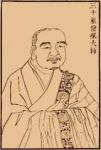
died 606

Sosan was the third patriarch of the Zen tradition of Buddhism. Sosan is the Japanese translation of the Chinese name Seng T’san (also known as Sengcan). Not much is known about Sosan, though he was a layman. His short work, The Book of Nothing (just 80 pages of poetry), is an inspiration to seekers of many traditions. The Book of Nothing succinctly, and very simply, captures the essence of the empty mind that in the generations following Sosan was to be the hallmark of the Zen tradition.

The empty mind, or no-mind, loosely describes the state in which reality is experienced directly without being filtered through the thought process of the mind. Without this filter, reality is experienced as completely fresh, radiant, and luminous — and, as if for the first time. Inherent in this experience is a feeling of both joy and bliss.

Like Bodhidharma (first patriarch) and Huike (second patriarch) before him, Sosan was reputed to be a devotee and specialist in the study of the Lankavatara Sutra, which taught the primacy of consciousness, the elimination of all duality, and the “forgetting of words and thoughts.”

An online collection of Sosan’s works is available at Terebess Asia Online.

The Heart of Existentialism

The refusal to belong to any school of thought, the repudiation of the adequacy of any body of beliefs whatever, and especially of systems, and a marked dissatisfaction with traditional philosophy as superficial, academic, and remote — that is the heart of existentialism.

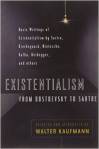
Existentialism from Dostoevsky to Sarte
Existentialism from Dostoevsky to Sartre

Walter Kaufmman
.
.

.


Some Key Existential Philosophers

Kierkegaard-Dostoyevsky-Nietzsche-Sartre -- Existential Philosophers

.
From left to right, top to bottom: Søren Kierkegaard, Fyodor Dostoevsky, Friedrich NietzscheJean-Paul Sartre